Scandinavian interiors are known for pale colors, simple furniture, natural materials and a calm sense of order. Yet when these ideas are copied too literally, the result can feel less like a welcoming Nordic home and more like an unfinished showroom.
The problem is rarely minimalism itself. Authentic Scandinavian interior design balances simplicity with comfort, natural texture, practical living and visual warmth. Rooms may be restrained, but they are rarely sterile.
If your Scandinavian-inspired home feels cold, sparse or impersonal, one or more of the following decorating mistakes may be responsible. The good news is that most are relatively easy to correct without abandoning the clean, understated character that makes the style so appealing.
10 Scandinavian Decorating Mistakes at a Glance
- Using too much bright white.
- Choosing a completely flat neutral palette.
- Removing too much furniture and decor.
- Ignoring natural materials.
- Using too little texture.
- Relying on one harsh overhead light.
- Choosing furniture that looks minimal but feels uncomfortable.
- Making the room excessively coordinated.
- Forgetting personal objects and artwork.
- Treating Scandinavian design as a fixed formula.
The most successful Scandinavian rooms avoid these problems by combining restraint with texture, warmth, functionality and personality.
Mistake #1. Using Too Much Bright White
White is strongly associated with Scandinavian interiors because it reflects daylight and helps rooms feel bright during long Nordic winters. The mistake is assuming that every wall, ceiling, sofa, curtain and accessory should therefore be brilliant white.
When too many large surfaces share the same stark white tone, a room can feel clinical rather than calm. Strong blue-white finishes can make the effect even colder, particularly under cool artificial lighting.
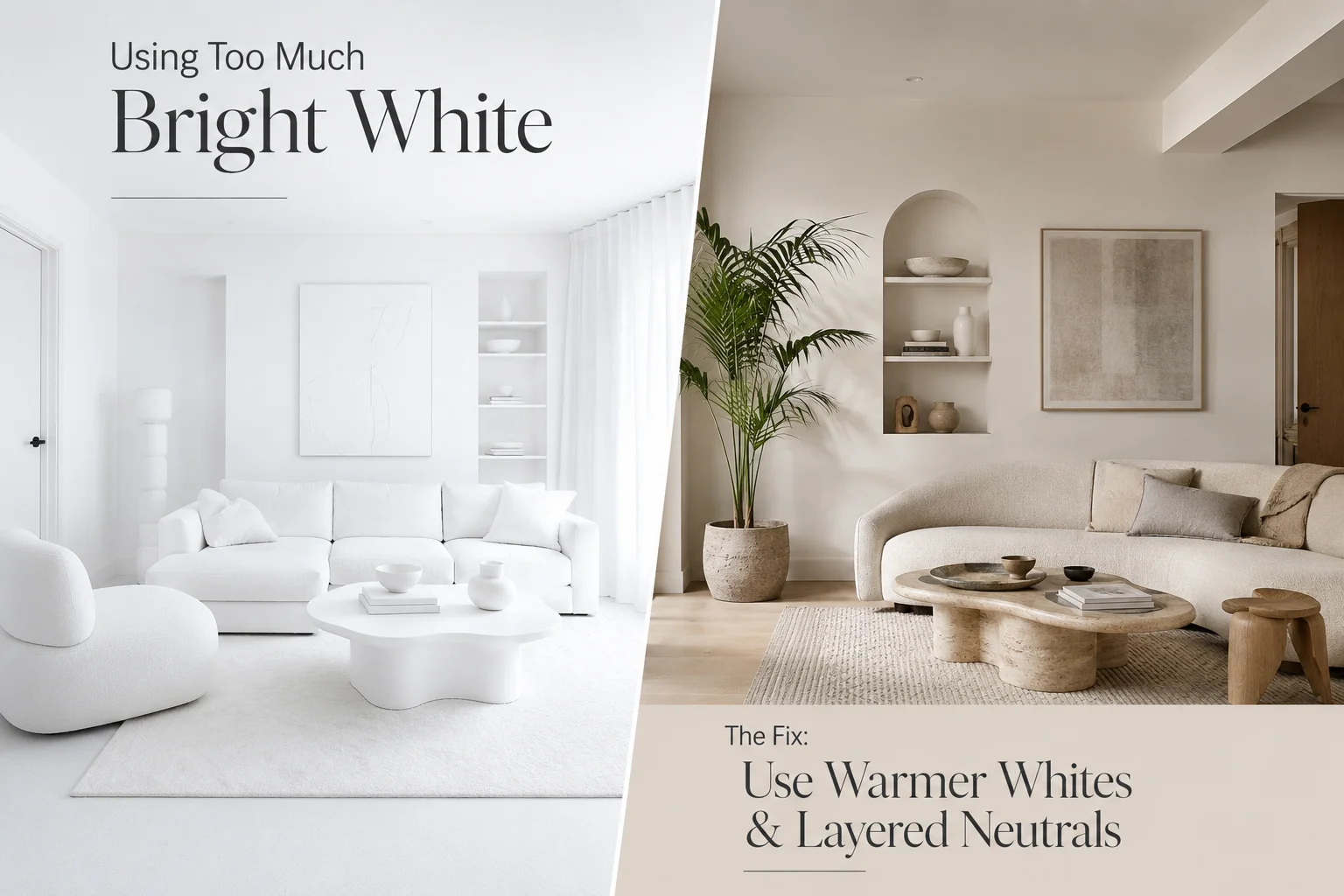
The Fix: Use Warmer Whites and Layered Neutrals
Instead of relying on one pure white throughout the room, introduce subtle tonal variation.
Consider combining:
- warm white or soft ivory walls;
- oatmeal, cream or flax upholstery;
- light beige textiles;
- pale oak or ash furniture;
- soft gray or greige accents;
- natural stone and ceramic finishes.
The differences may be subtle, but they create depth while maintaining the light, understated appearance associated with Scandinavian style.
For a deeper understanding of how color works within the aesthetic, refer to your guide to Scandinavian design principles.
Mistake #2. Choosing a Completely Flat Neutral Palette
A neutral Scandinavian room does not have to be colorless. One common decorating mistake is removing so much color that every surface becomes white, beige or pale gray with almost no contrast.
Without darker notes, natural variation or muted accents, the room may appear washed out and visually flat.
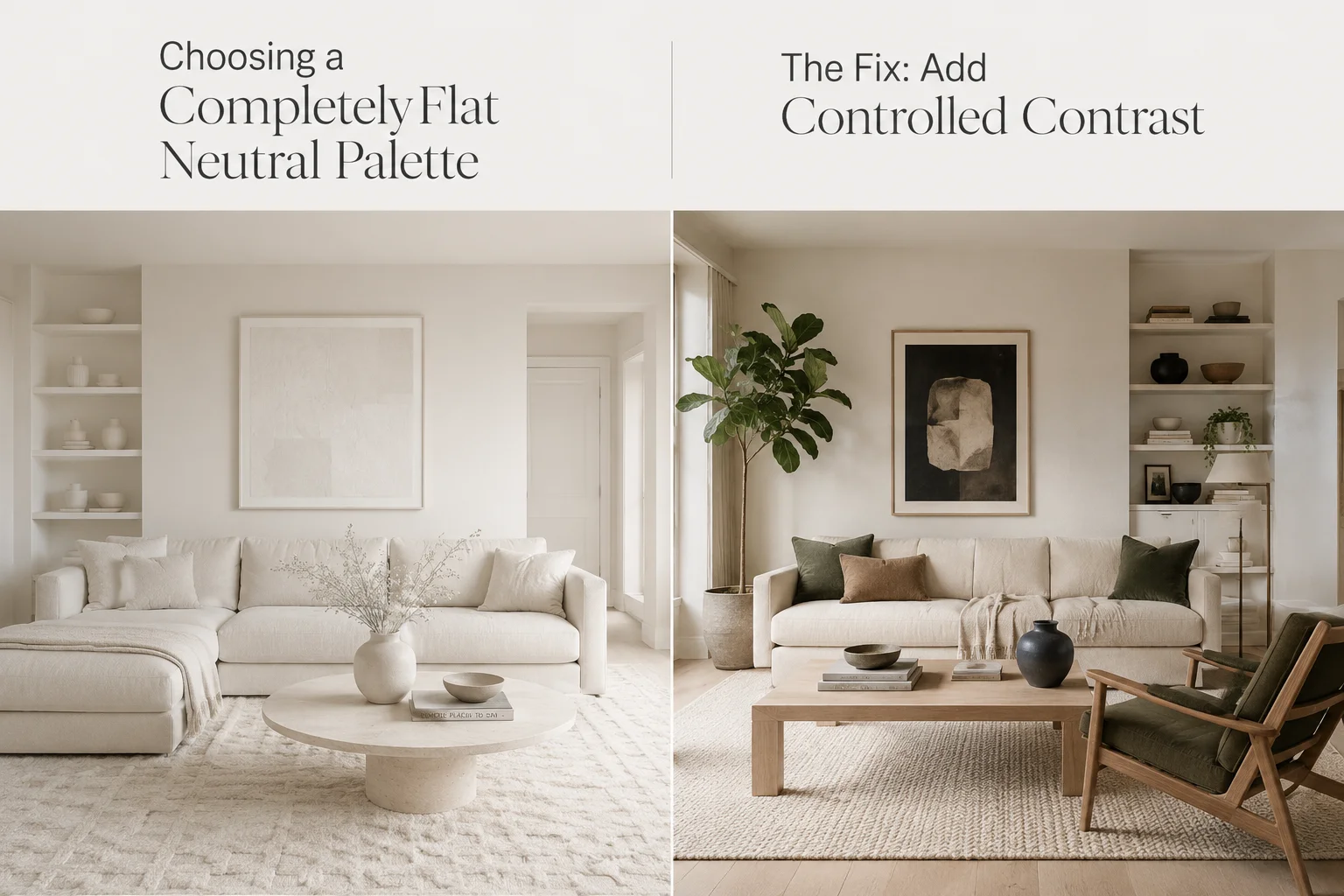
The Fix: Add Controlled Contrast
Use neutral colors as the foundation, then introduce a small number of deeper or earthier tones.
Suitable Scandinavian accents can include:
- charcoal;
- soft black;
- forest or sage green;
- muted blue;
- rust;
- ochre;
- terracotta;
- dusty rose.
These colors do not need to dominate the room. A dark lamp, olive cushion, muted artwork or rust-colored throw may provide enough contrast to make pale materials feel more intentional.
Natural wood also functions as color. Oak, walnut, birch and ash introduce warmth without disrupting a restrained palette.
Mistake #3. Removing Too Much Furniture and Decor
Scandinavian design values simplicity, but simplicity is not the same as emptiness.
Rooms sometimes feel cold because homeowners remove almost everything in pursuit of minimalism. The resulting space may contain a sofa, coffee table and rug but lack the secondary layers that make a room feel comfortable and lived in.
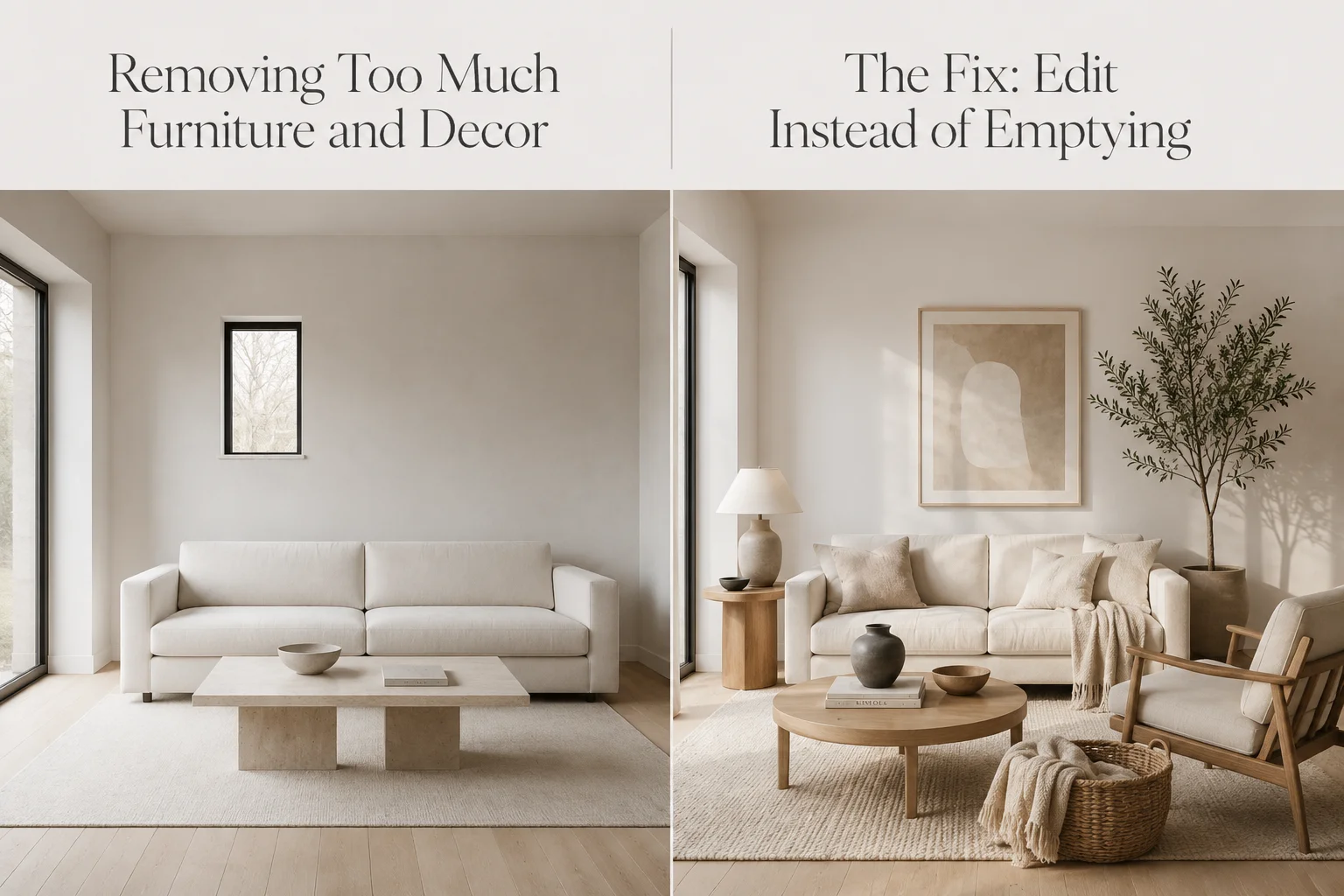
The Fix: Edit Instead of Emptying
A Scandinavian room should contain what is useful, meaningful or visually supportive—without unnecessary clutter.
You might add:
- a comfortable lounge chair;
- a floor or table lamp;
- a side table;
- a basket for throws;
- a few books;
- a ceramic vessel;
- a plant;
- one or two meaningful decorative objects.
The goal is not to fill every surface. It is to create enough visual and functional layering that the room feels complete.
A useful rule is to remove objects that create noise while keeping pieces that add function, texture, craftsmanship or personal meaning.
Mistake #4. Ignoring Natural Materials
A room can follow a Scandinavian color palette and still feel wrong if most of its surfaces are synthetic, glossy or overly manufactured.
Natural materials are one of the main reasons genuine Nordic interiors feel warm even when the architecture and palette are restrained.
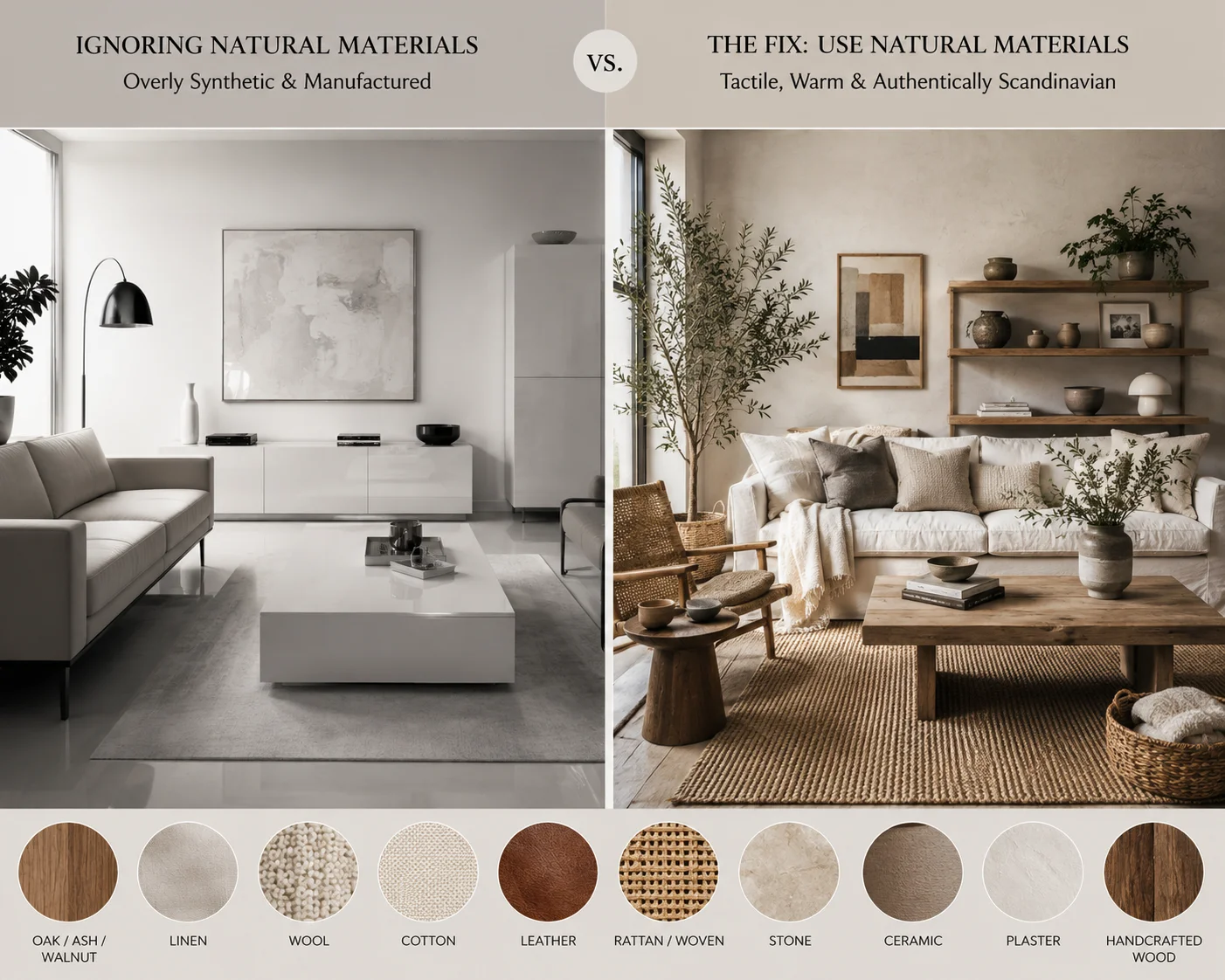
The Fix: Introduce Visible Natural Materials
Prioritize materials with tactile and visual variation, including:
- oak, ash, birch or walnut;
- linen;
- wool;
- cotton;
- leather;
- rattan or woven fibers;
- stone;
- ceramic;
- plaster;
- handcrafted wood.
You do not need to replace every synthetic surface. Even a few carefully chosen natural elements can transform the mood of a room.
A solid wood coffee table, linen curtains, wool rug and handmade ceramic bowl immediately introduce variation that glossy laminates and plastic accessories often lack.
Natural materials also tend to age gracefully, reinforcing the timeless quality central to Scandinavian interior design.
Mistake #5. Using Too Little Texture
Texture is one of the most important—and frequently overlooked—ingredients in Scandinavian decorating.
When the palette is restrained and furniture is simple, texture provides much of the room’s visual interest. Without it, neutral interiors can quickly feel flat and unfinished.
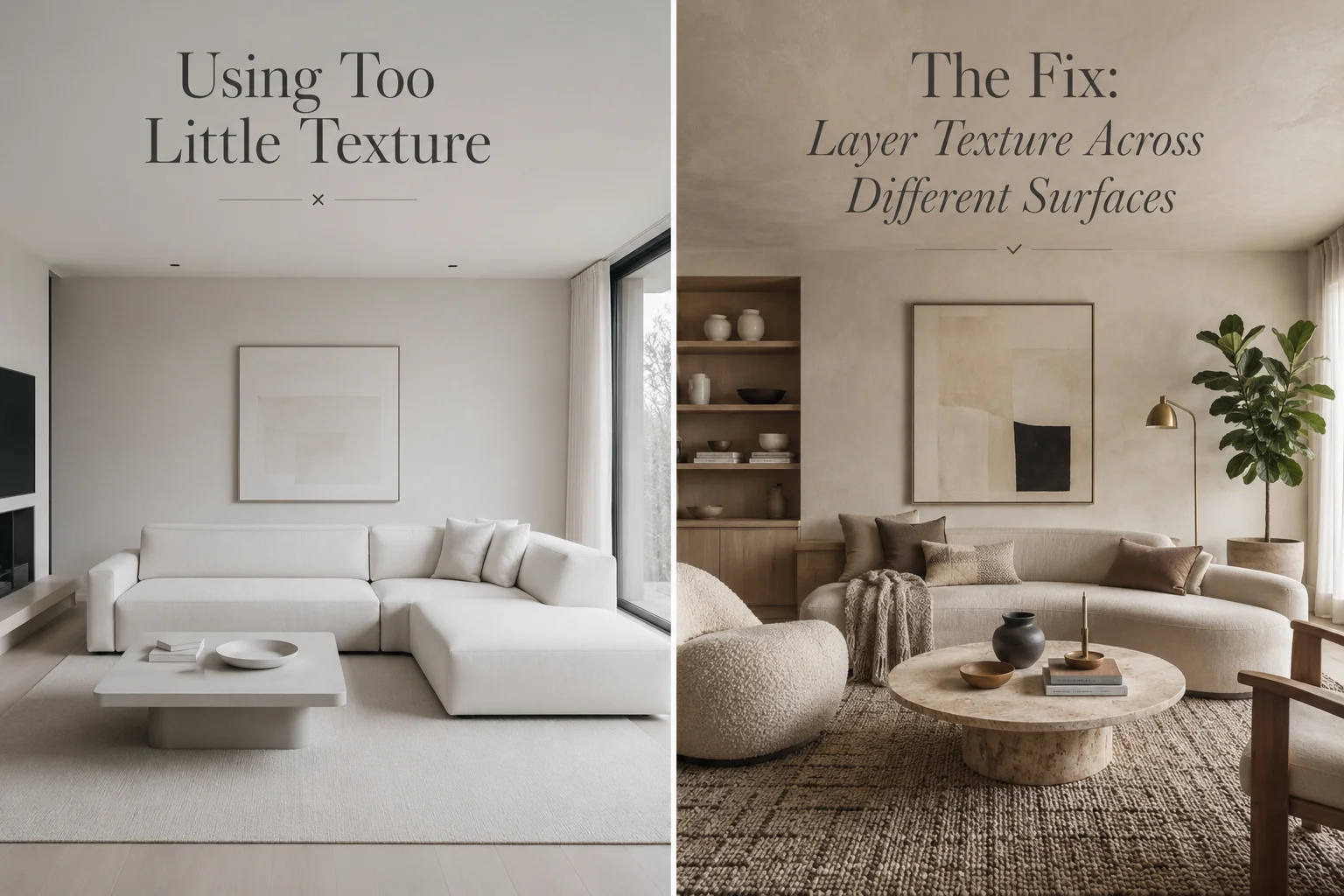
The Fix: Layer Texture Across Different Surfaces
Rather than introducing more decorative objects, create depth through material contrast.
Combine surfaces such as:
- smooth timber;
- nubby wool;
- washed linen;
- bouclé;
- woven cotton;
- matte ceramic;
- brushed metal;
- natural stone;
- subtle plaster;
- soft upholstery.
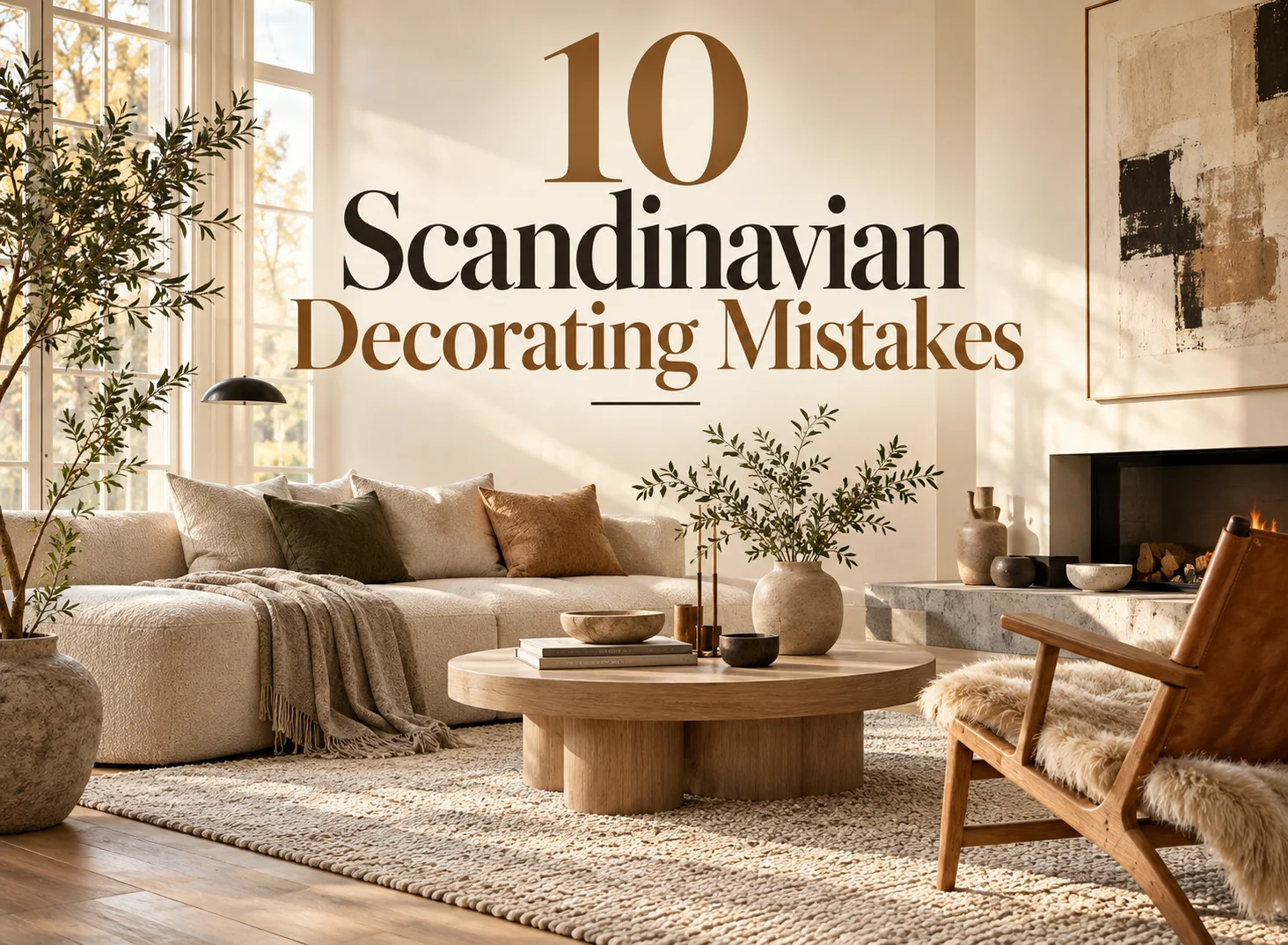
A Scandinavian living room might pair a streamlined sofa with a wool rug, linen cushions, oak table, ceramic vase and soft throw. None of these elements needs to be visually loud. Their contrasting textures create richness quietly.
Texture is especially important when working with white, beige and gray because it prevents similarly colored objects from visually blending into one flat surface.
Mistake #6. Relying on One Harsh Overhead Light
Few things make a Scandinavian room feel cold faster than a single bright ceiling fixture with a cool color temperature.
Lighting plays an unusually important role in Nordic interiors because natural daylight changes dramatically throughout the year. Scandinavian decorating therefore tends to use multiple sources of soft light rather than treating illumination as purely functional.
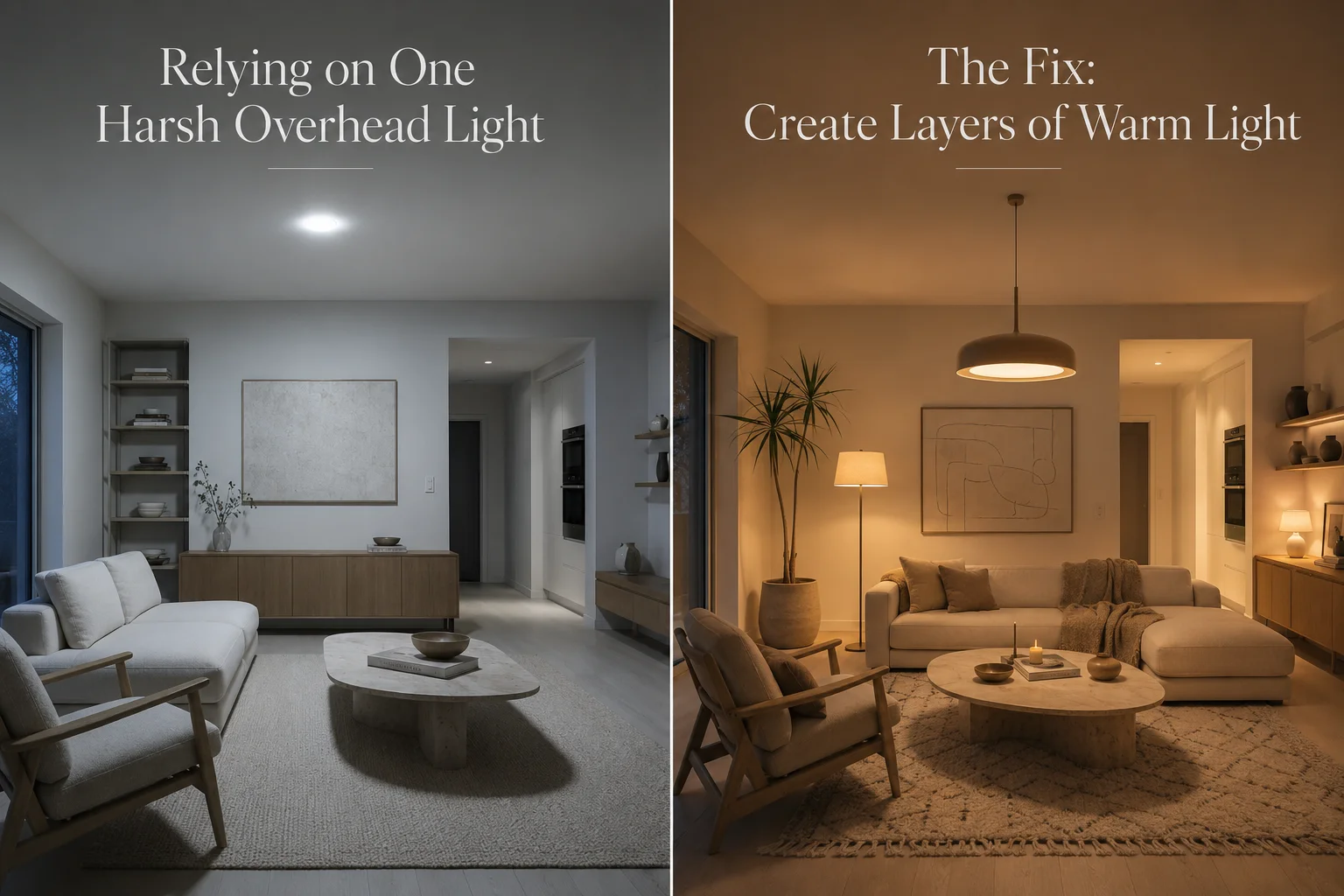
The Fix: Create Layers of Warm Light
Combine several types of lighting:
- ambient lighting for overall illumination;
- task lighting beside reading chairs, desks or sofas;
- accent lighting to create atmosphere and highlight selected areas;
- decorative lighting through pendants, table lamps or sculptural fixtures.
Warm or warm-neutral bulbs generally create a more inviting atmosphere than very cool light.
Instead of expecting one ceiling light to illuminate the entire living room, place smaller light sources at different heights. A pendant, floor lamp and table lamp can create far more depth than one intense fixture.
This layered approach is central to creating the cozy atmosphere often associated with the Scandinavian concept of hygge.
Mistake #7. Choosing Furniture That Looks Minimal but Feels Uncomfortable
Scandinavian furniture may appear clean and visually light, but good Nordic design rarely sacrifices usability for appearance.
A common mistake is choosing an extremely rigid sofa, undersized lounge chair or delicate table simply because it looks minimalist in a photograph.
If furniture does not support everyday living, the space can feel formal and emotionally cold even when it looks stylish.
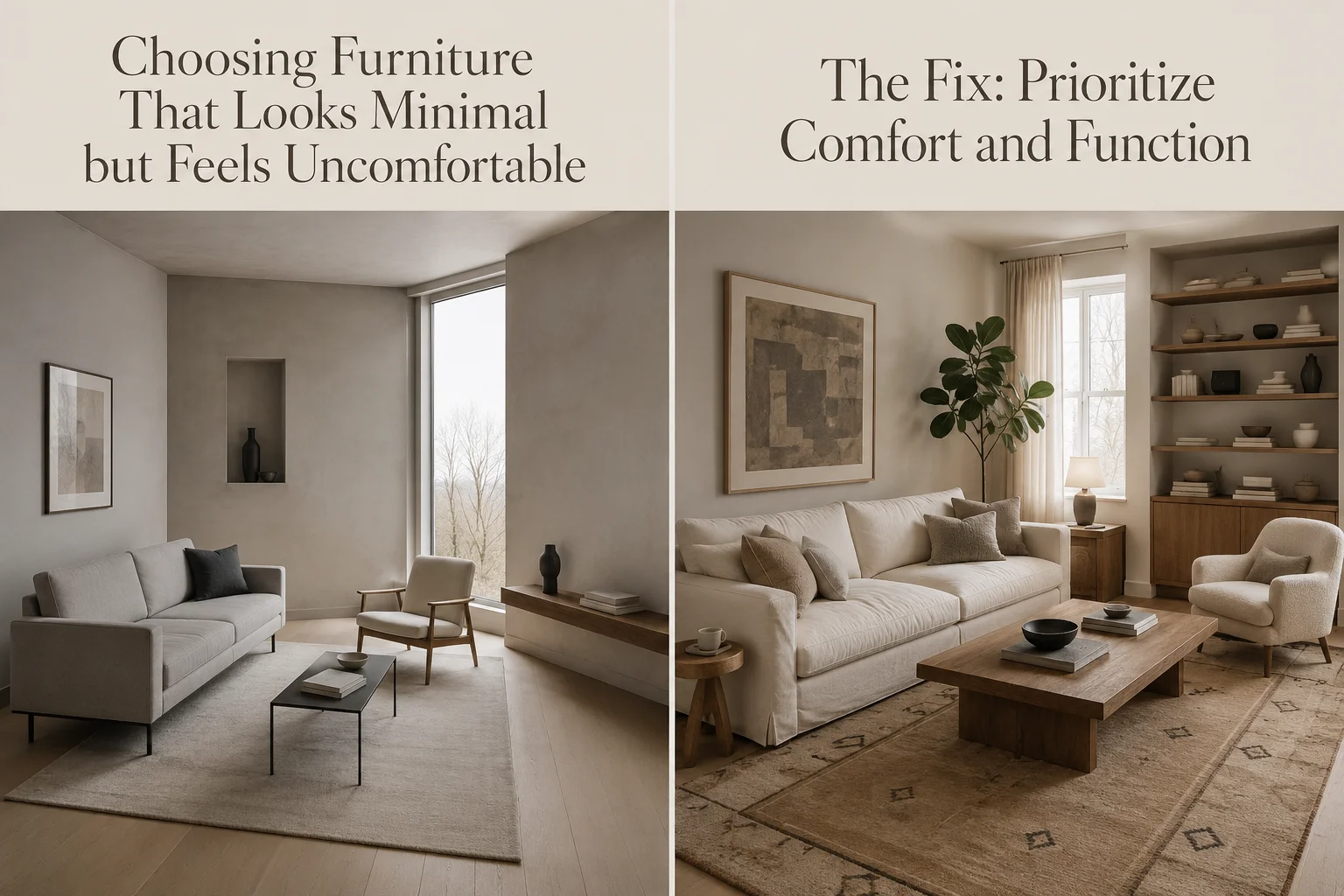
The Fix: Prioritize Comfort and Function
Before buying furniture, consider how each piece will actually be used.
Look for:
- supportive but comfortable seating;
- appropriate seat depth;
- durable upholstery;
- tables positioned within easy reach;
- storage where it is genuinely needed;
- furniture scaled correctly for the room.
A generous linen sofa can still look Scandinavian. So can a deeply upholstered lounge chair or a substantial wooden dining table.
The important distinction is that forms remain visually considered rather than unnecessarily decorative.
If you are furnishing a living space from scratch, our guide on how to create a Scandinavian living room explains how to combine furniture, layout, materials and lighting in a practical sequence.
Mistake #8. Making Everything Too Coordinated
Buying every piece from the same furniture collection may appear to be an easy way to create cohesion, but it can also make a Scandinavian room feel like a showroom.
Authentic interiors often evolve gradually and contain pieces from different periods, designers, makers and price points.
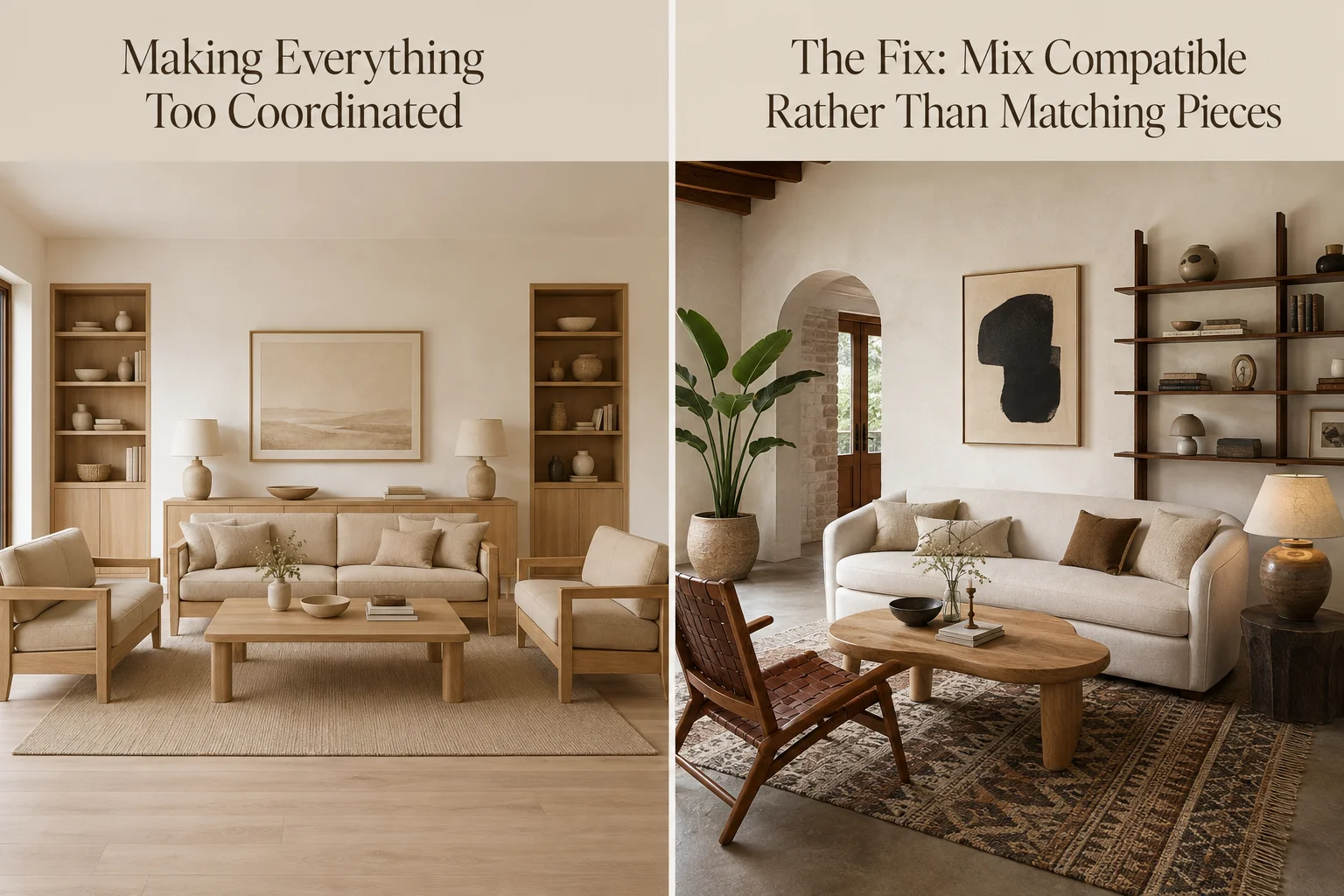
The Fix: Mix Compatible Rather Than Matching Pieces
Instead of repeating the same wood finish, upholstery and furniture silhouette throughout the room, create subtle variation.
You might combine:
- a contemporary sofa;
- a vintage Scandinavian chair;
- a simple oak coffee table;
- a handcrafted ceramic lamp;
- a woven rug;
- modern artwork.
The pieces do not need to match exactly. They only need enough commonality in material, proportion, palette or design simplicity to feel connected.
This approach creates a room that feels collected over time rather than purchased as a complete set.
Mistake #9. Forgetting Personal Objects and Artwork
Minimalism can become impersonal when every book, photograph, artwork and decorative object is removed.
Scandinavian design values thoughtful editing, but homes are still meant to reflect the people who live in them.
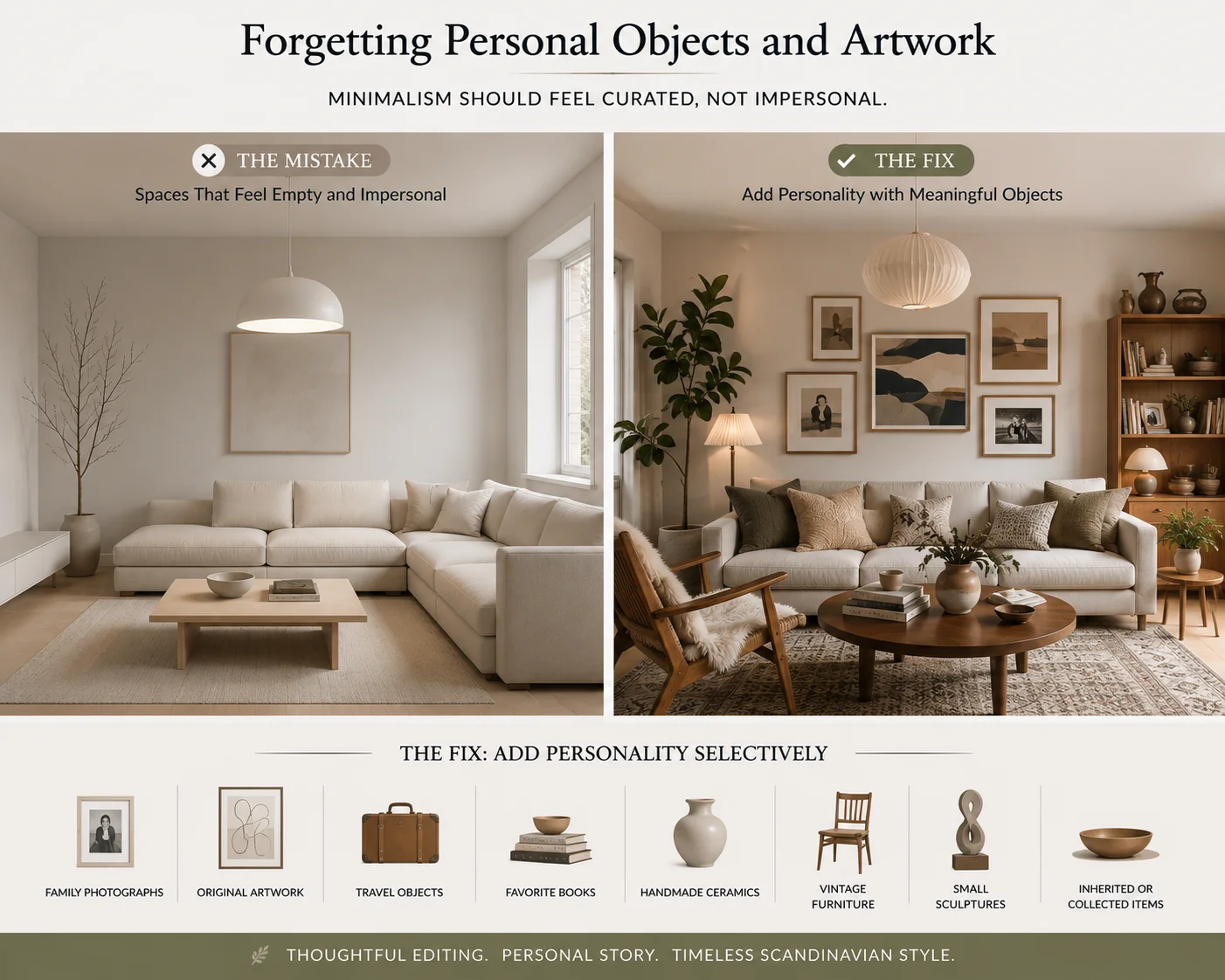
The Fix: Add Personality Selectively
Choose a limited number of objects that tell a story or contribute visually.
Consider:
- family photographs in simple frames;
- original or collected artwork;
- travel objects;
- favorite books;
- handmade ceramics;
- vintage furniture;
- small sculptures;
- objects inherited or collected over time.
The key is curation. Instead of displaying twenty unrelated accessories, select a few pieces and give them enough breathing room to be appreciated.
Personal objects prevent a neutral interior from feeling generic while preserving the quiet character of Scandinavian design.
Mistake #10. Treating Scandinavian Design as a Fixed Formula
Perhaps the biggest Scandinavian decorating mistake is assuming the style has one rigid recipe: white walls, pale oak, gray sofa, black lamp and a single plant.
Those ingredients can work, but they represent only one interpretation of Nordic design.
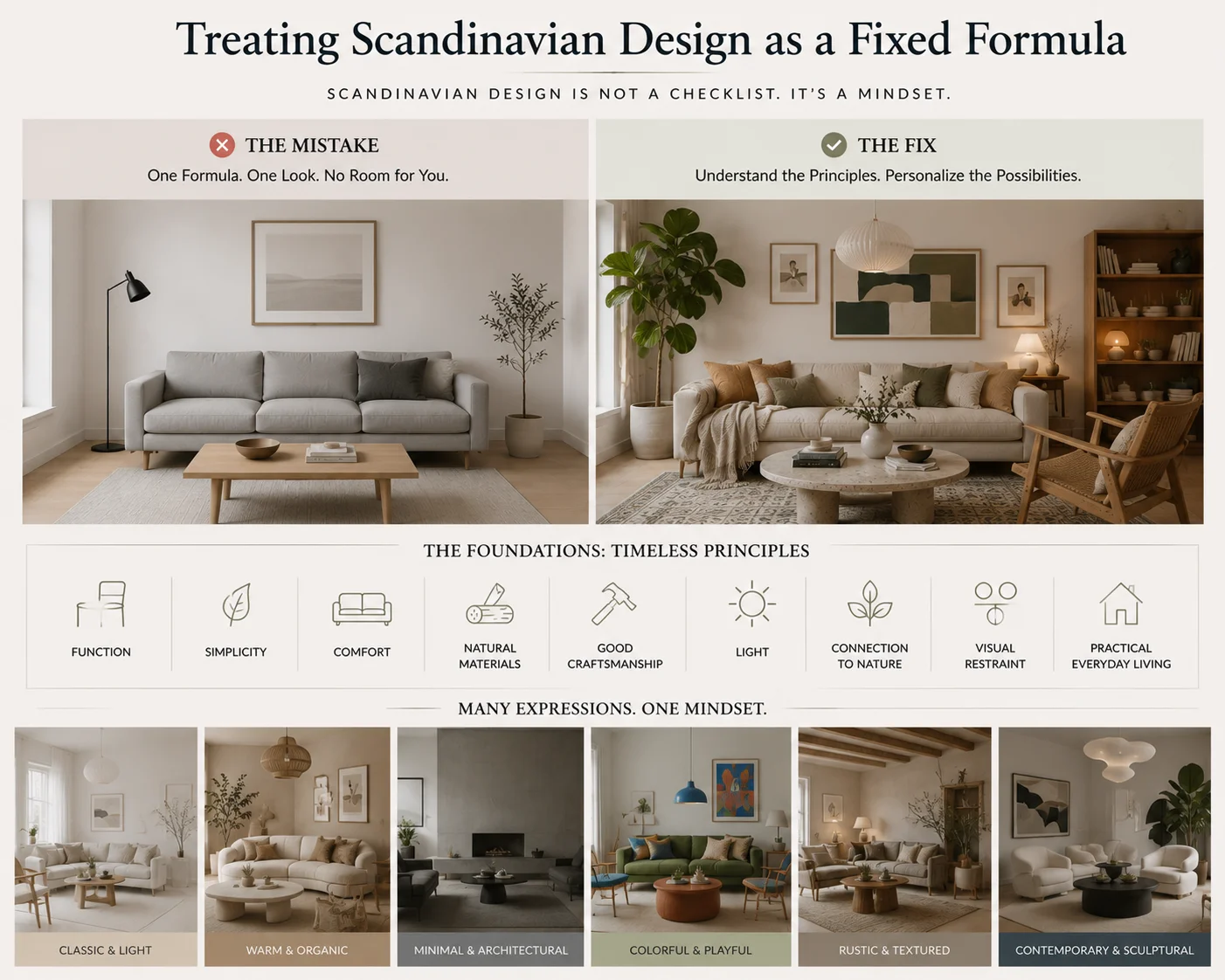
The Fix: Understand the Principles, Then Personalize Them
Instead of copying a formula, focus on the deeper ideas behind the style:
- function;
- simplicity;
- comfort;
- natural materials;
- good craftsmanship;
- light;
- connection to nature;
- visual restraint;
- practical everyday living.
Once those foundations are understood, the style can be adapted in many directions.
A Scandinavian room might feel:
- classic and light;
- warm and organic;
- minimal and architectural;
- colorful and playful;
- rustic and textured;
- contemporary and sculptural.
Our Scandinavian Living Room Style Guide explores these variations in greater detail and shows how the same core principles can produce very different interiors.
How to Make a Scandinavian Home Feel Warmer
If your home already has a Scandinavian foundation but feels slightly cold, you usually do not need to redesign everything.
Start with the elements that have the greatest emotional impact:
- replace stark white with warmer neutral tones;
- introduce visible wood;
- add a larger wool or textured rug;
- layer linen, wool and cotton textiles;
- use warmer lamps at multiple heights;
- bring in plants or natural branches;
- add artwork with muted color;
- incorporate handmade or vintage objects;
- choose comfortable rather than purely sculptural seating.
Even three or four of these changes can significantly alter how the room feels.
Designer Tip: Warmth Comes From Contrast
A warm Scandinavian interior does not depend on covering the room with beige.
It comes from contrast between different experiences: smooth and textured, pale and dark, new and old, structured and soft, practical and personal.
For example, a simple white wall becomes warmer beside an oak cabinet. A clean-lined sofa becomes more inviting with a wool throw. A minimalist shelf feels more personal when it contains a handmade ceramic piece and several carefully chosen books.
The individual elements remain restrained, but their relationships create depth.
Shop the Look: Scandinavian Warmth Essentials
If you are correcting a room that feels too cold, focus on pieces that add texture, softness and natural variation rather than simply introducing more decor.
- Wool or wool-blend rug: Adds softness and visually anchors the seating area.
- Linen cushions: Introduce relaxed texture without excessive pattern.
- Soft wool throw: Makes streamlined seating feel more comfortable.
- Oak side or coffee table: Brings warmth and natural grain into a neutral room.
- Ceramic table lamp: Combines tactile material with atmospheric lighting.
- Woven storage basket: Adds natural texture while keeping everyday clutter controlled.
- Handmade ceramic vase: Introduces subtle imperfection and craftsmanship.
- Large indoor plant: Adds organic shape and color to pale architectural surfaces.
Choose only the categories your room genuinely needs. Scandinavian styling is usually more successful when each addition has a clear purpose.
Style Variations: Warm Scandinavian Alternatives
If classic pale Scandinavian decor still feels too restrained for your taste, consider one of these related interpretations.
Organic Scandinavian
Add stronger natural textures, curved furniture, stone, limewash, tactile upholstery and additional greenery while maintaining a quiet neutral foundation.
Rustic Scandinavian
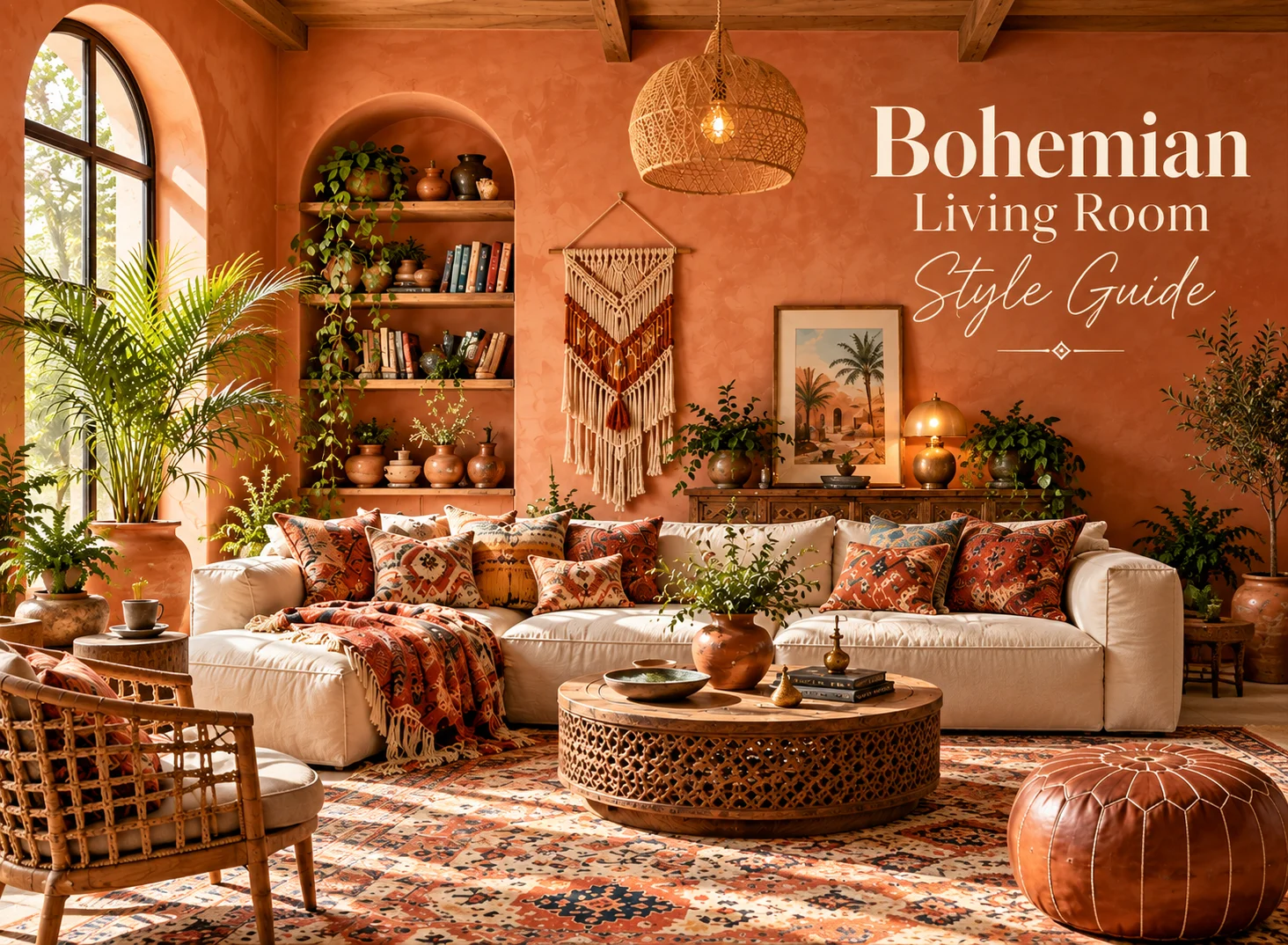
Use more visible timber grain, vintage furniture, woven textiles, aged finishes and handmade objects for a softer, lived-in appearance.
Colorful Scandinavian
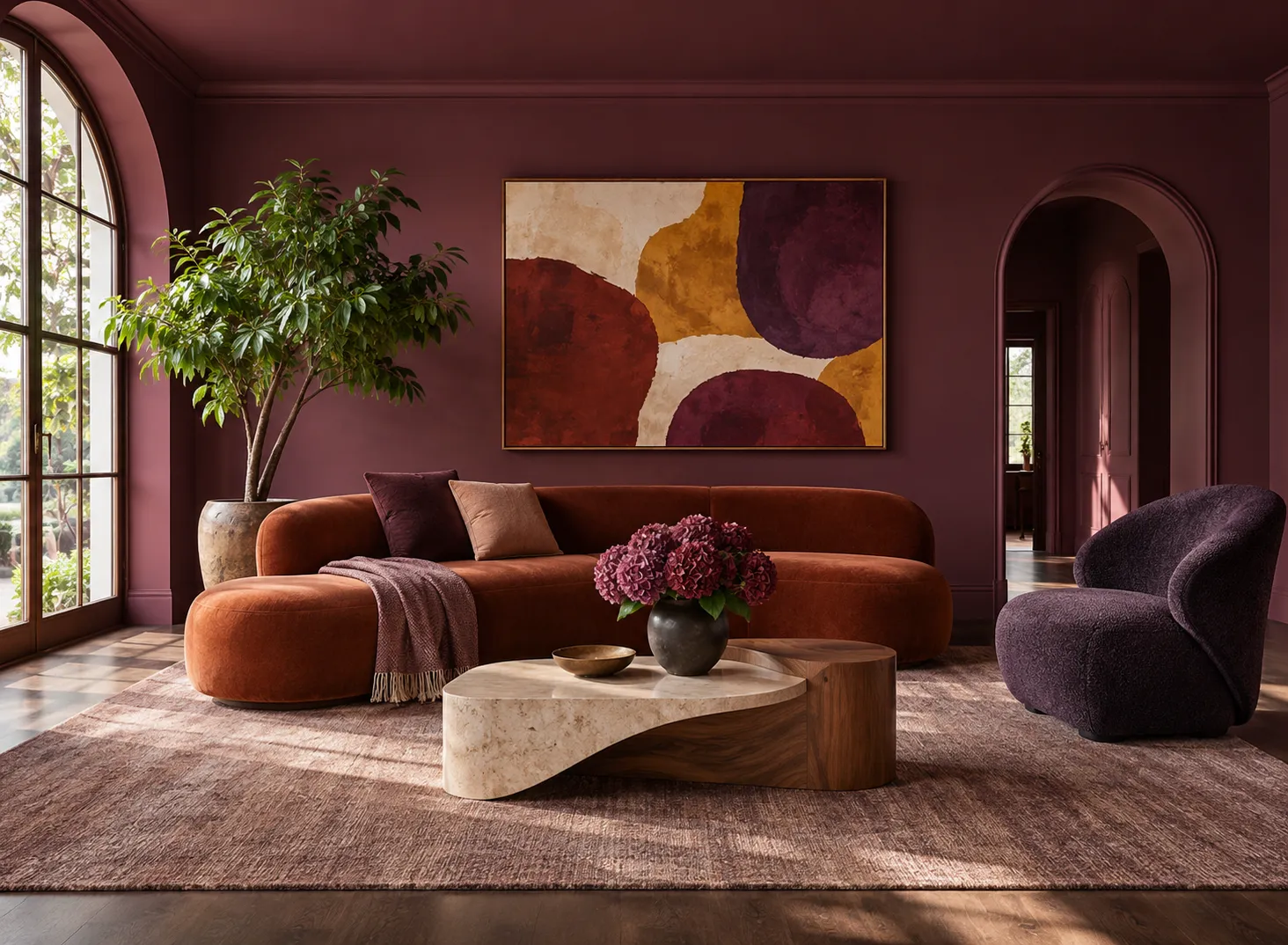
Introduce muted blue, green, rust, ochre or dusty pastels through upholstery, artwork and accessories while keeping furniture forms relatively simple.
Modern Scandinavian
Combine restrained Nordic materials with contemporary architecture, cleaner geometry, sculptural lighting and selected statement furniture.
These variations demonstrate why understanding the underlying Scandinavian design principles is more useful than copying one recognizable decorating formula.
Frequently Asked Questions About Scandinavian Decorating Mistakes
Why does my Scandinavian room feel cold?
A Scandinavian room often feels cold when it relies too heavily on bright white, pale gray and minimal furniture without enough natural wood, textiles, texture, warm lighting or personal objects. Layering natural materials and warmer neutral tones usually makes the space feel more inviting.
Does Scandinavian decor have to be white?
No. White is common because it reflects natural light, but Scandinavian interiors also use warm neutrals, wood tones, muted greens, blues, rust, ochre, soft gray and occasional darker accents. The overall palette is typically controlled rather than completely colorless.
How do you make Scandinavian decor cozy?
Use wool rugs, linen curtains, textured cushions, throws, natural wood, layered lighting, plants and carefully selected personal objects. Cozy Scandinavian rooms balance clean design with tactile materials and comfortable furniture.
Can Scandinavian interiors use dark colors?
Yes. Charcoal, black, deep blue, forest green and darker wood can provide useful contrast. Dark colors usually work best as controlled accents or selected surfaces rather than overwhelming the light overall composition.
Can Scandinavian design have a lot of plants?
Yes, although the arrangement is usually intentional. One or two substantial plants can introduce organic shape, movement and color without creating visual clutter. Smaller plants can also work when grouped selectively.
Is Scandinavian style the same as minimalism?
No. The two approaches overlap in their preference for simplicity and visual restraint, but Scandinavian design generally places greater emphasis on warmth, natural materials, comfort, craftsmanship and practical everyday living.
Final Thoughts
The most common Scandinavian decorating mistakes happen when the style is reduced to its most visible characteristics rather than understood as a complete design philosophy.
White walls, pale wood and minimal furniture alone do not create a successful Scandinavian interior. The warmth comes from what surrounds those elements: tactile textiles, layered lighting, natural materials, comfortable proportions, craftsmanship and carefully chosen personal details.
If your room feels cold, resist the temptation to simply add more decorations. Instead, examine the balance of color, texture, material, lighting and comfort.
A well-designed Scandinavian home should feel calm without feeling empty, simple without feeling sterile and refined without losing the sense that real people live there.
For a broader foundation, explore our Scandinavian Interior Design: The Complete Guide, then use the Scandinavian Living Room Style Guide and How to Create a Scandinavian Living Room guide to translate these principles into a complete room.