Contemporary interior design is defined by the way we live and decorate now. Rather than belonging to one fixed historical period, the style continually evolves as architecture, furniture, materials and lifestyles change.
Today’s contemporary interiors tend to feel clean and considered without being severe. Comfortable furniture, natural materials, sculptural shapes, restrained color palettes, generous negative space and carefully layered texture frequently appear together. The result is a home that feels current and sophisticated while remaining practical enough for everyday life.
One of the biggest advantages of contemporary design is its flexibility. A contemporary home can feel warm and organic, minimal and architectural, sophisticated and luxurious or colorful and expressive. What connects these variations is not a specific sofa, color or material, but a shared emphasis on clarity, proportion, quality and intentional design.
In this complete guide, you will learn what contemporary interior design means, how it differs from modern design, the colors and materials that define it, how to select furniture and lighting, how to use the style throughout different rooms and how to create a contemporary home without making it feel cold or overly trendy.
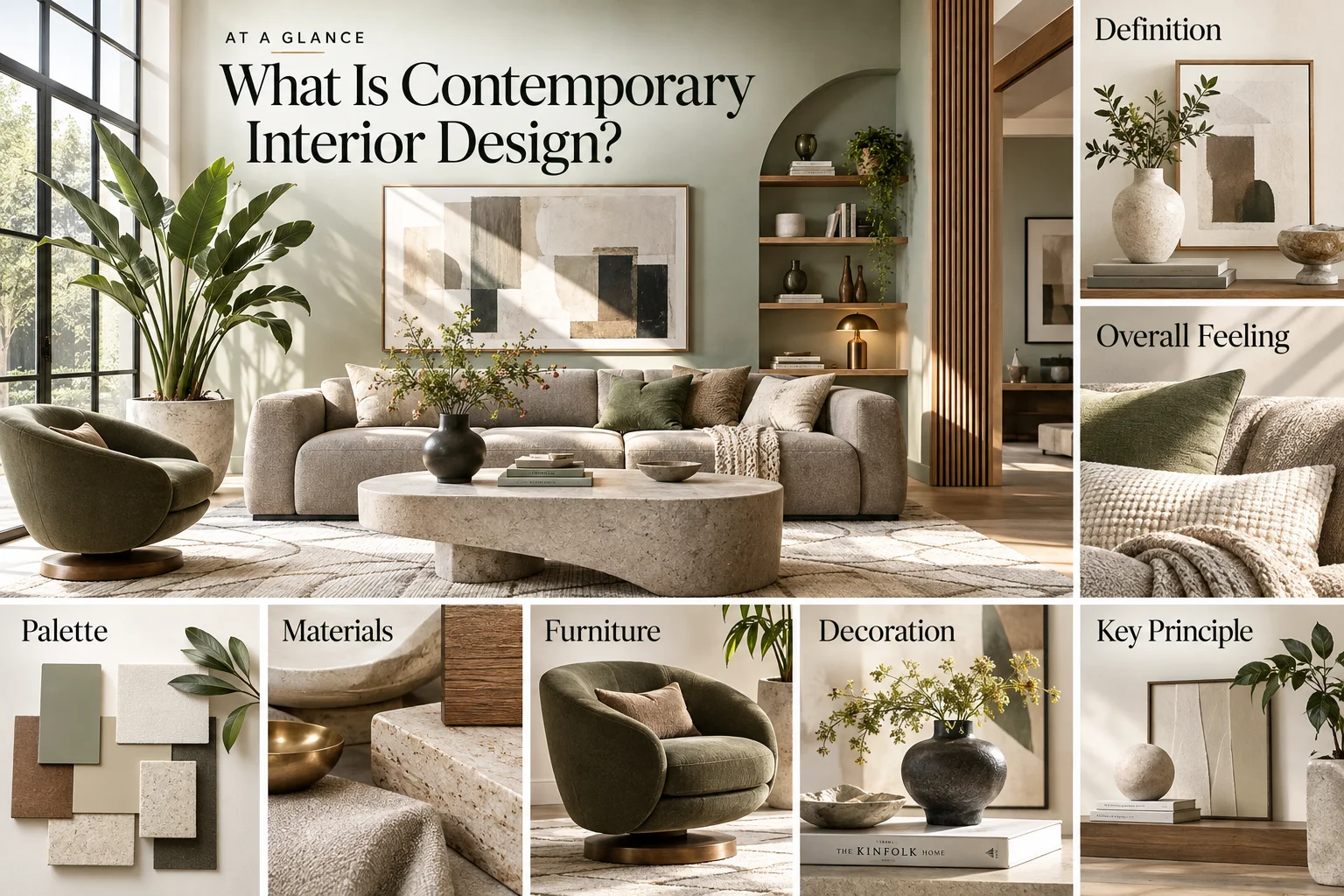
What Is Contemporary Interior Design?
Contemporary interior design is an evolving design style that reflects the architecture, materials, furniture and decorating ideas considered relevant to present-day living.
Unlike styles connected to a particular historical movement, contemporary design does not have one permanent visual formula. A contemporary interior created several decades ago may look noticeably different from a contemporary room designed today.
That flexibility allows contemporary interiors to borrow selectively from other movements. Modernism contributes clean lines and functional planning. Minimalism contributes visual restraint. Scandinavian design can introduce warmth and practical simplicity, while organic modern interiors contribute natural materials and softer forms.
The key is editing.
A contemporary room rarely attempts to display every current design idea at once. Instead, the strongest spaces combine relatively simple foundations with a limited number of distinctive elements: perhaps an architectural sofa, a substantial stone coffee table, expressive lighting or one oversized artwork.
At a Glance
- Definition: An evolving style influenced by current design thinking
- Overall feeling: Clean, comfortable, intentional and sophisticated
- Typical palette: Warm neutrals with controlled accent colors
- Common materials: Wood, stone, glass, metal, linen, wool and plaster
- Furniture: Simple but distinctive silhouettes with strong proportions
- Decoration: Edited rather than excessive
- Key principle: Let space, materials and form contribute as much as decoration
How Contemporary Design Evolved
Contemporary design is unusual because it cannot be traced to a single period in the same way as Art Deco, Bauhaus or mid-century modern design.
The word contemporary simply refers to the present time. As a result, contemporary interiors naturally change.
Late twentieth-century contemporary interiors frequently emphasized polished surfaces, glass, chrome, strong geometry and increasingly open floor plans. During later decades, minimalism and cool neutral palettes became especially influential.
More recent contemporary homes have generally become warmer and more tactile. Natural stone, visible wood grain, textured upholstery, softly rounded furniture, handmade objects and warmer neutral colors can now coexist with clean architectural lines.
This evolution explains why defining contemporary design through a rigid shopping list is difficult. The deeper principles are more useful than individual trends.
Those principles include simplicity, visual balance, practical living, quality materials, intentional contrast and enough negative space for important furniture and objects to be appreciated.
Key Characteristics of Contemporary Interior Design
Contemporary interiors can vary substantially, but several characteristics appear consistently.
Clean Visual Composition
Contemporary rooms tend to feel visually organized. Furniture placement, artwork, lighting and decoration are selected deliberately rather than accumulated randomly.
This does not mean everything must be symmetrical. Contemporary spaces frequently use asymmetrical compositions, but visual weight is carefully balanced.
Simple and Sculptural Forms
Furniture often combines simple silhouettes with one distinctive quality.
A sofa may have a clean profile but softly curved arms. A coffee table may be little more than a solid block of travertine, yet the natural stone gives it considerable presence.
This balance allows furniture to remain relatively restrained while still giving the room character.
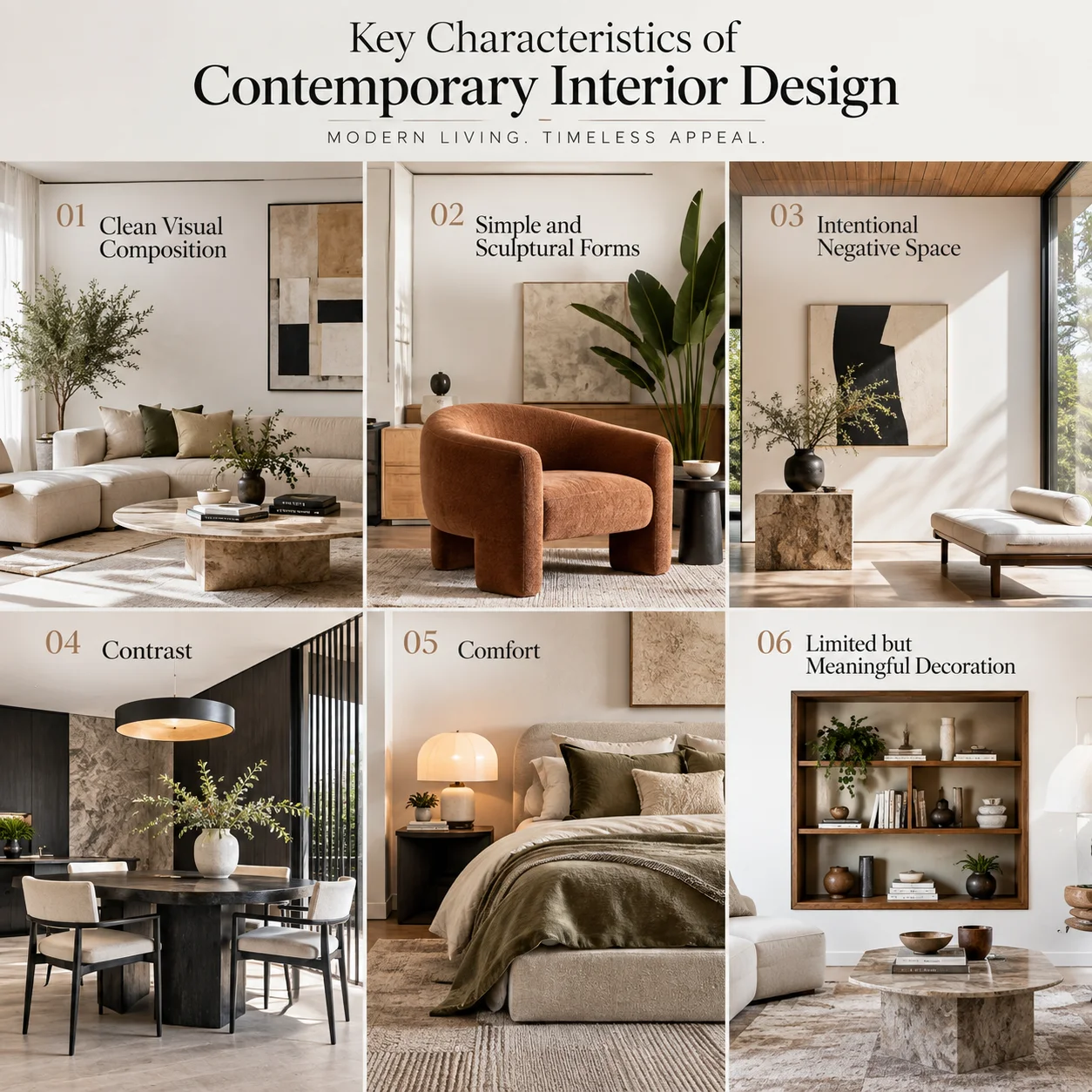
Intentional Negative Space
Empty space is an active design element.
Contemporary interiors rarely require furniture in every corner, artwork on every wall or accessories covering every surface. Leaving space around an important chair, table or artwork often gives it greater visual impact.
Contrast
Contrast prevents clean interiors from becoming flat.
Contemporary rooms may combine:
- straight architectural lines with rounded furniture;
- rough stone with smooth glass;
- dark timber with light upholstery;
- matte walls with reflective metal;
- large-scale furniture with delicate lighting;
- neutral foundations with one expressive color.
Comfort
Contemporary design should work for real life.
A beautiful sofa that nobody enjoys sitting on is rarely a successful choice. Increasingly, contemporary furniture combines architectural form with generous proportions, practical fabrics and relaxed comfort.
Limited but Meaningful Decoration
Instead of filling surfaces with numerous small accessories, contemporary rooms often use fewer objects with stronger shapes, interesting materials or personal meaning.
A handmade ceramic vessel, sculptural lamp or large framed artwork can contribute more than many unrelated decorative objects.
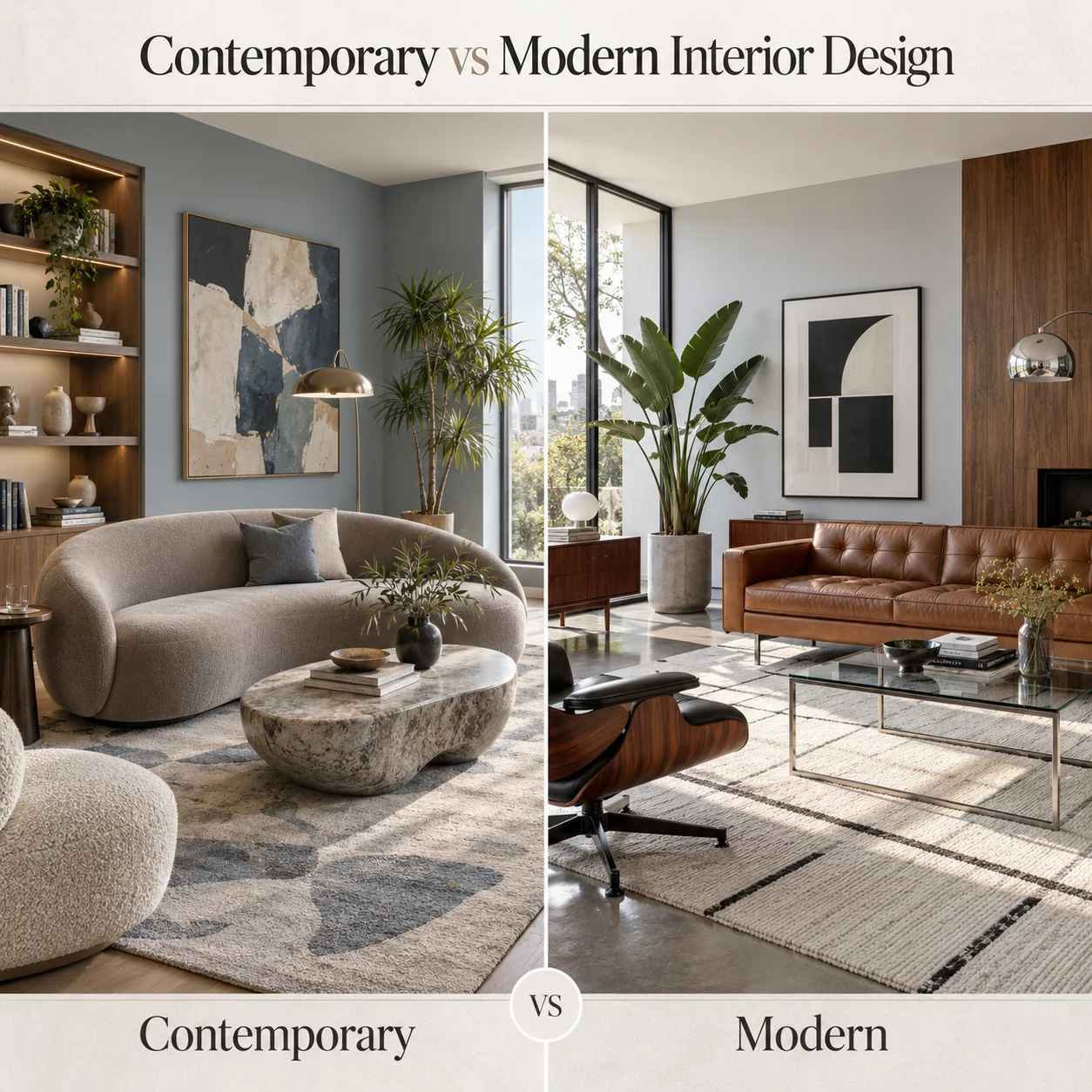
Contemporary vs Modern Interior Design
Contemporary and modern are often used interchangeably, but they do not mean exactly the same thing.
Modern design is associated primarily with twentieth-century Modernism and related movements. Contemporary design describes what feels current today.
Contemporary Design | Modern Design |
|---|---|
| Continually evolves | Connected to established twentieth-century movements |
| Can combine straight and organic lines | Often emphasizes clean geometric forms |
| Frequently mixes current materials and influences | Strong relationship with wood, steel, glass and functional construction |
| May incorporate current trends selectively | Uses principles established by Modernism |
| Can range from warm and organic to polished and minimal | Typically feels more historically identifiable |
There is considerable overlap because contemporary interiors have inherited many ideas from modern design. Clean lines, functional layouts, open spaces and reduced ornament are common to both.
The easiest distinction is time: modern is historically rooted; contemporary keeps changing.
Contemporary Interior Design Color Palette
A neutral foundation is common in contemporary interiors because it allows furniture, materials and architectural shapes to become more visible.
However, contemporary design does not require an entirely beige, white or gray home.
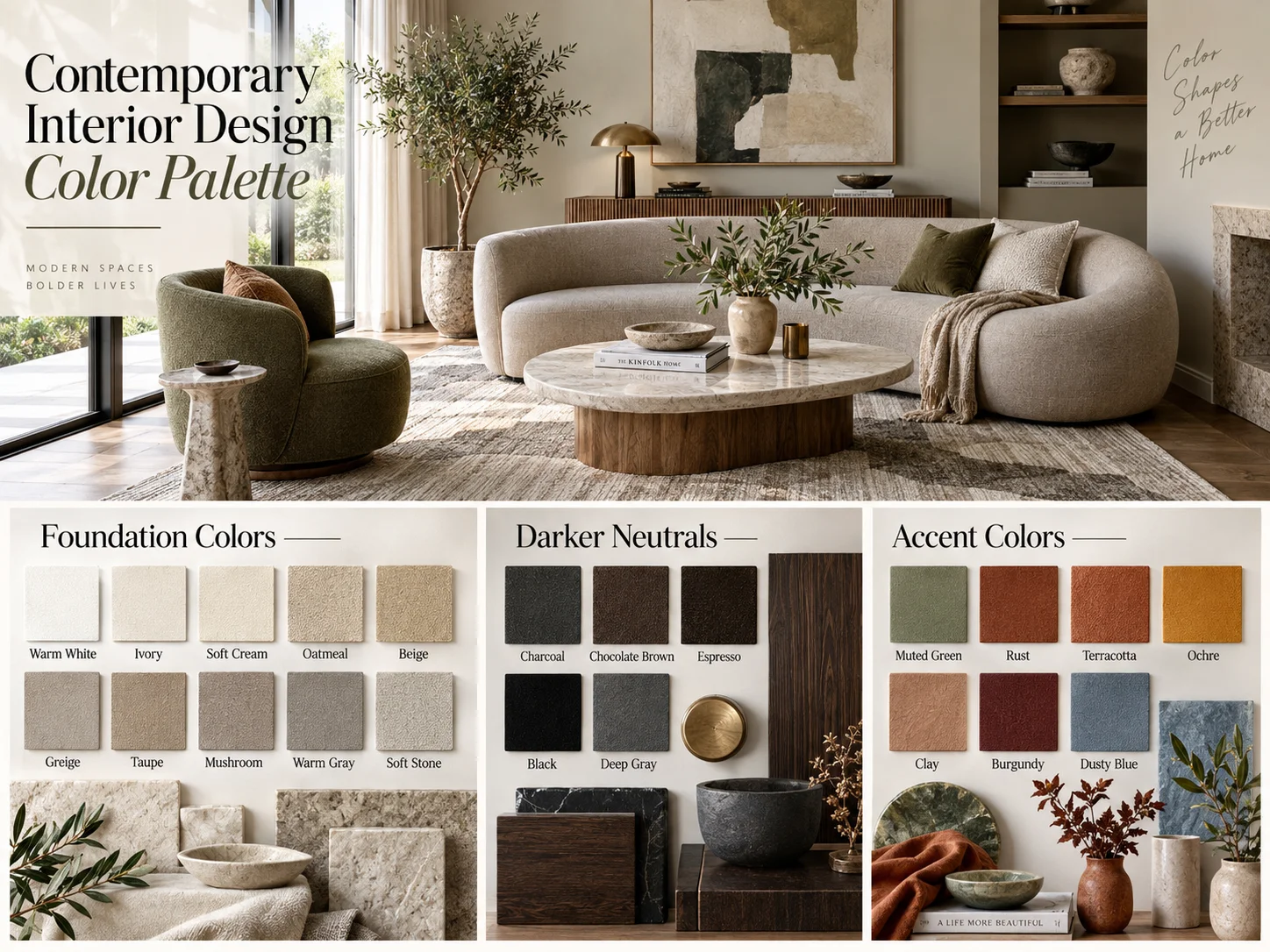
Foundation Colors
- Warm white
- Ivory
- Soft cream
- Oatmeal
- Beige
- Greige
- Taupe
- Mushroom
- Warm gray
- Soft stone
Darker Neutrals
Charcoal, chocolate brown, espresso, black and deep gray can provide definition through furniture, cabinetry, architectural details and occasional feature walls.
Accent Colors
Muted greens, rust, terracotta, ochre, clay, burgundy, dusty blue and other complex colors can work especially well because they sit comfortably beside natural materials.
More saturated colors can also work when they are used intentionally.
Designer Tip: Instead of trying to use every fashionable color, choose a neutral foundation and one or two accent families. Repeat them selectively through artwork, upholstery or smaller objects to make the room feel connected.
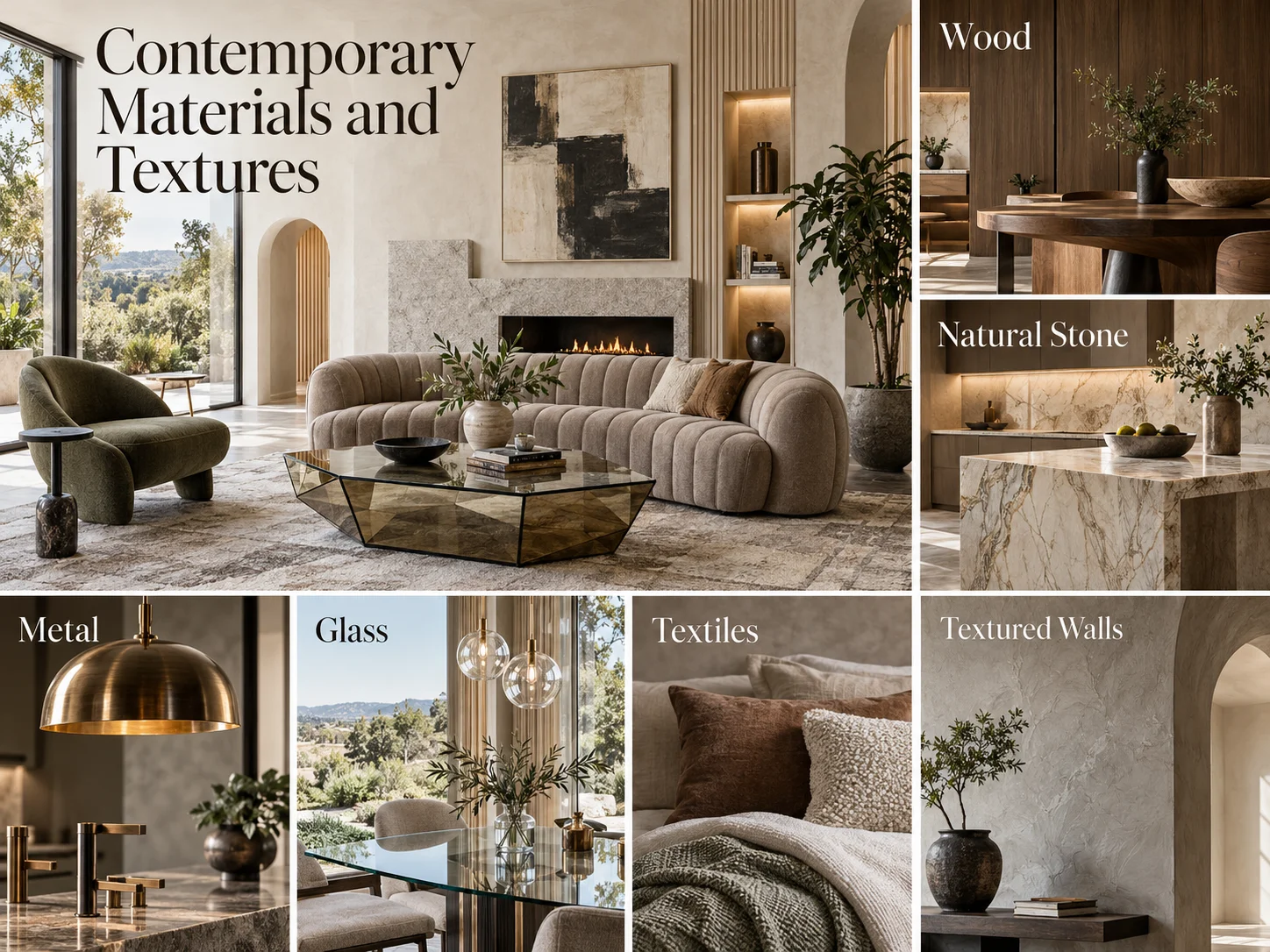
Contemporary Materials and Textures
Material contrast is one of the easiest ways to make contemporary rooms feel sophisticated.
Wood
Natural timber adds warmth and visual variation.
Oak, walnut and darker stained woods can appear through flooring, cabinetry, dining tables, consoles, occasional chairs and wall paneling.
Furniture does not need to use an identical timber finish throughout the house. A controlled mixture usually feels more natural than a perfectly matched furniture set.
Natural Stone
Marble, travertine, limestone, granite and other stones introduce weight, texture and unique pattern.
Use stone where its character can be appreciated: countertops, fireplaces, coffee tables, side tables or architectural surfaces.
Metal
Blackened steel, bronze, brass, chrome and brushed nickel can add definition.
Metal is especially effective in lighting, furniture frames, hardware and smaller structural details.
Glass
Glass can reduce visual weight and introduce reflection without adding another strong color.
Use it selectively through tables, doors, lighting and architectural partitions.
Textiles
Linen, wool, cotton, velvet, bouclé and other tactile fabrics soften architectural surfaces.
If the room has a restrained color palette, vary the texture instead.
For example, combine a smooth woven sofa with a thick wool rug, linen curtains, a boucle chair and a softly textured cushion rather than introducing five additional colors.
Plaster, Concrete and Textured Walls
Subtle plaster, limewash-inspired finishes and concrete can add depth while maintaining a quiet visual foundation.
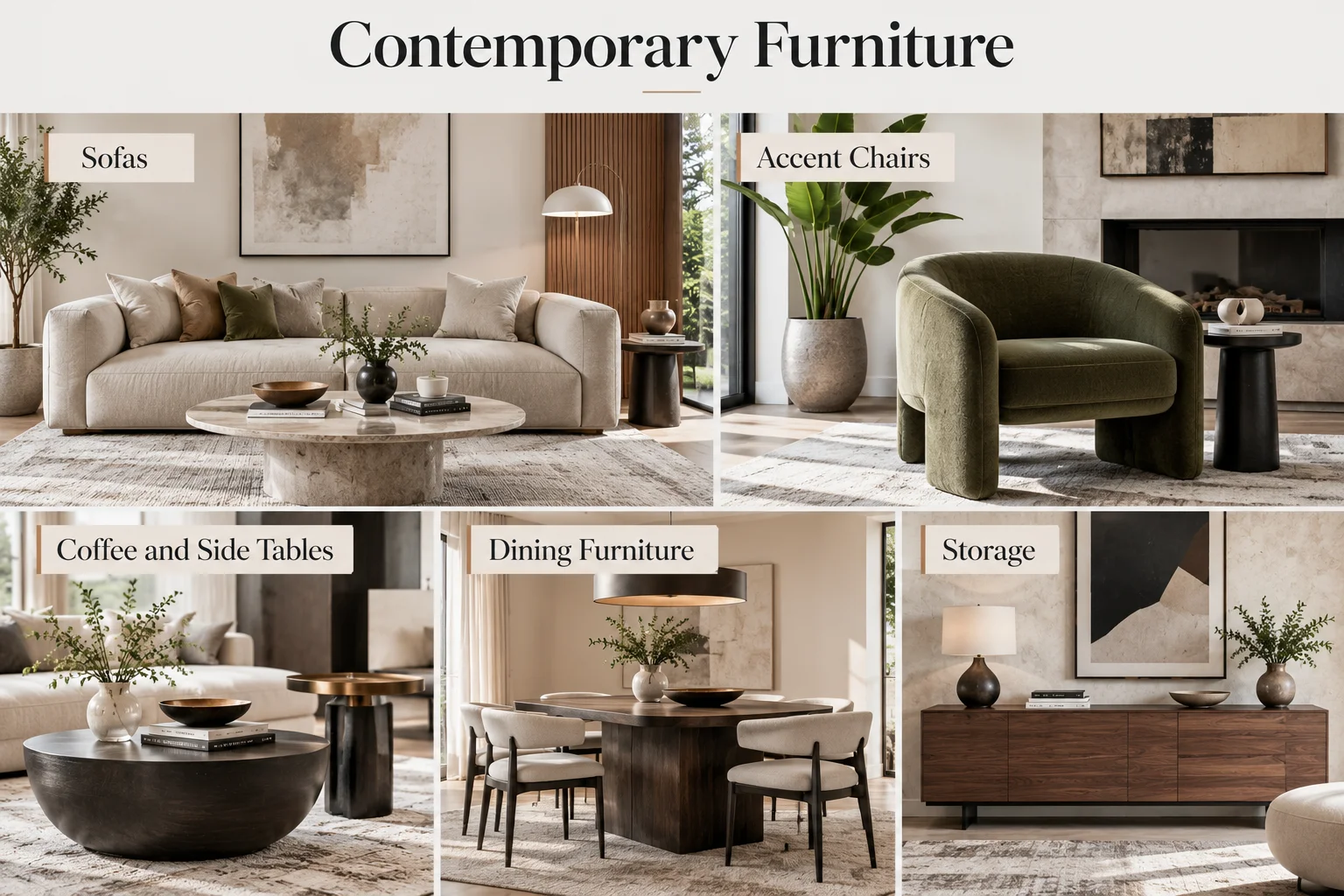
Contemporary Furniture
Contemporary furniture should look deliberate without sacrificing comfort.
Sofas
Look for:
- clean or gently rounded silhouettes;
- low to medium profiles;
- generous seating depth;
- quality upholstery;
- simple arms;
- limited decorative detailing.
Sectionals can work particularly well in larger contemporary living spaces when their scale is appropriate to the room.
Accent Chairs
Use chairs to introduce a contrasting shape.
A curved upholstered chair can soften a rectangular sofa, while a slim timber-frame chair can reduce visual weight beside heavier furniture.
Coffee and Side Tables
Contemporary tables frequently make materials the main decorative feature.
Consider solid wood, travertine, marble, glass, metal or combinations of these materials.
Dining Furniture
A simple but substantial dining table can become an architectural anchor.
Instead of automatically buying a matching table-and-chair set, consider combining compatible pieces with slightly different materials or silhouettes.
Storage
Closed-front storage helps maintain visual calm.
Long, low consoles, built-in cabinetry, handleless doors and integrated storage can reduce clutter while reinforcing clean architectural lines.
For detailed room-specific recommendations, visit our Contemporary Living Room Style Guide.
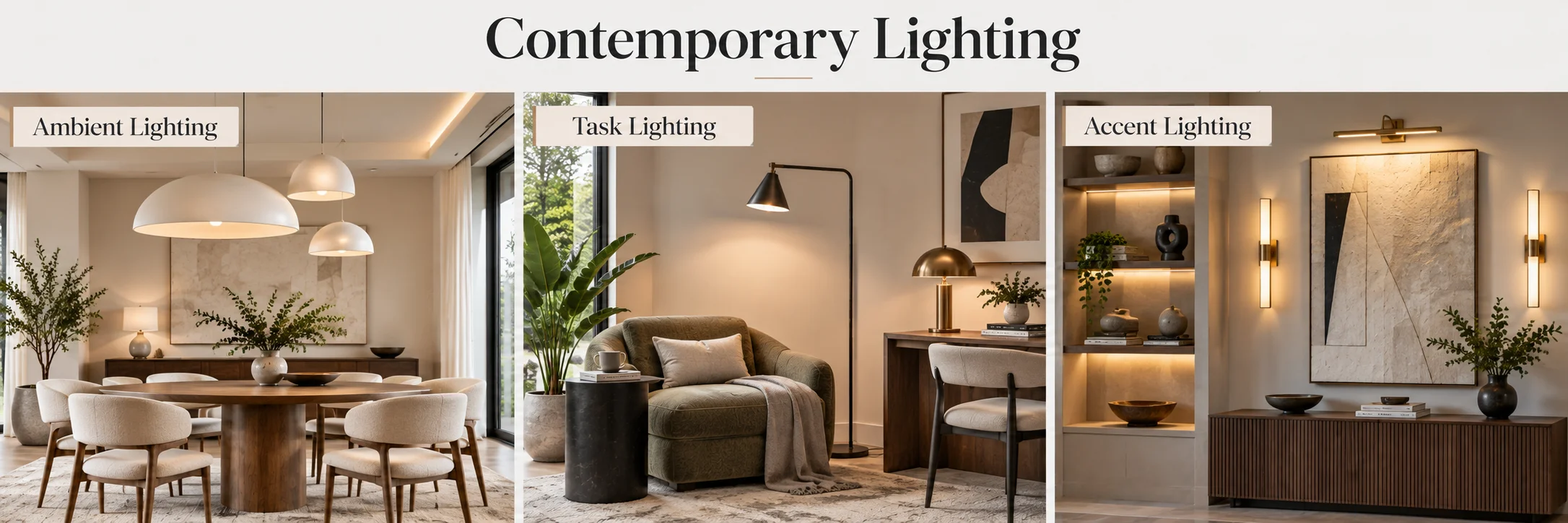
Contemporary Lighting
Lighting has two roles in contemporary design: illumination and sculpture.
Ambient Lighting
Pendants, chandeliers and recessed architectural lighting can provide general illumination.
Task Lighting
Floor lamps, reading lights, desk lamps and under-cabinet lighting support specific activities.
Accent Lighting
Sconces, picture lights and small lamps can emphasize artwork, shelving or architectural surfaces.
The most comfortable interiors combine multiple light sources positioned at different heights.
Contemporary Lighting Formula: Use one architectural or sculptural focal light, then support it with quieter floor, table or wall lighting. The statement fixture should not have to illuminate the entire room by itself.
Layout, Scale and Negative Space
A contemporary room often looks expensive because of proportion rather than because every individual object is expensive.
Start With Scale
Choose furniture that relates properly to the room.
Small furniture scattered throughout a large room can feel less sophisticated than fewer generously scaled pieces.
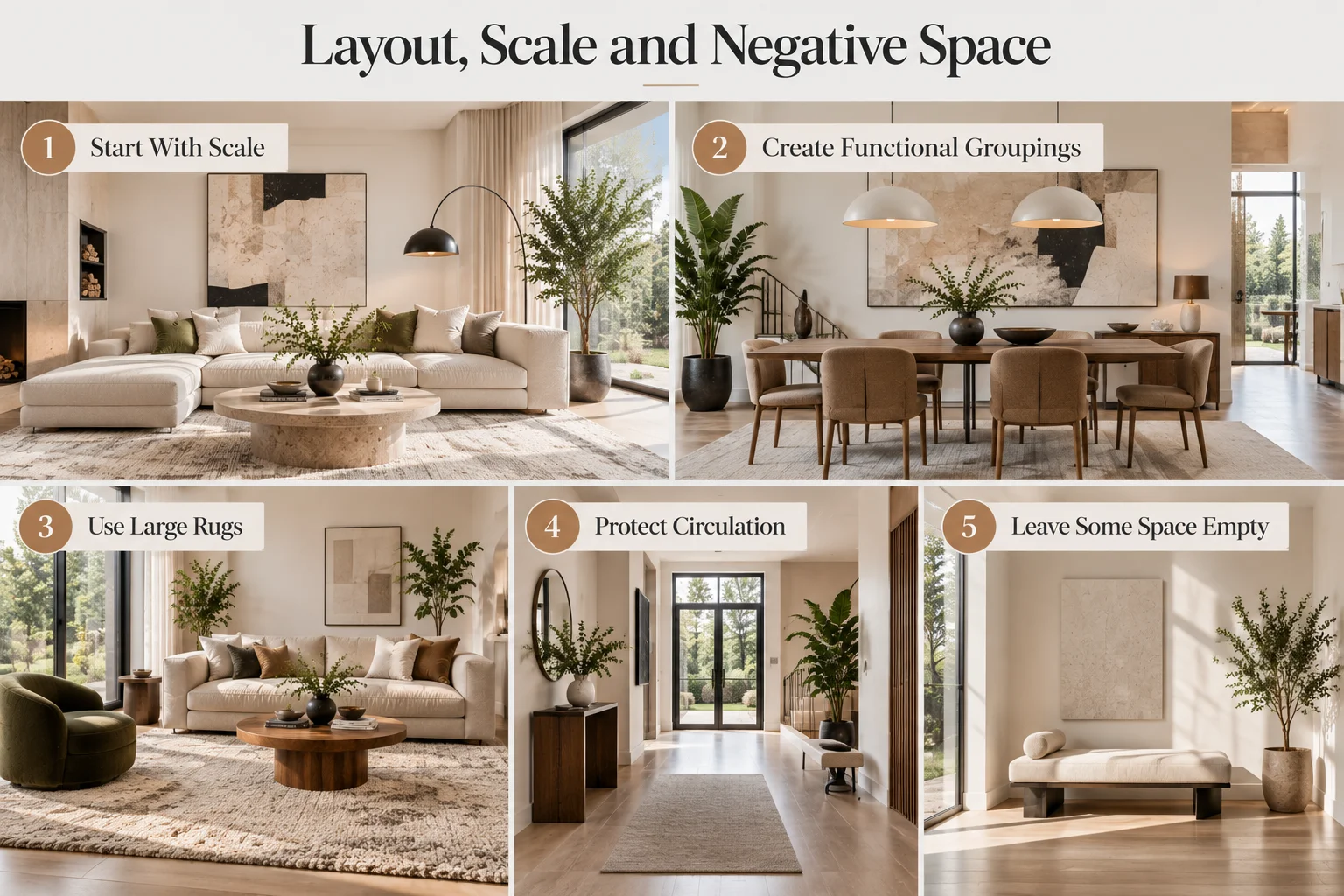
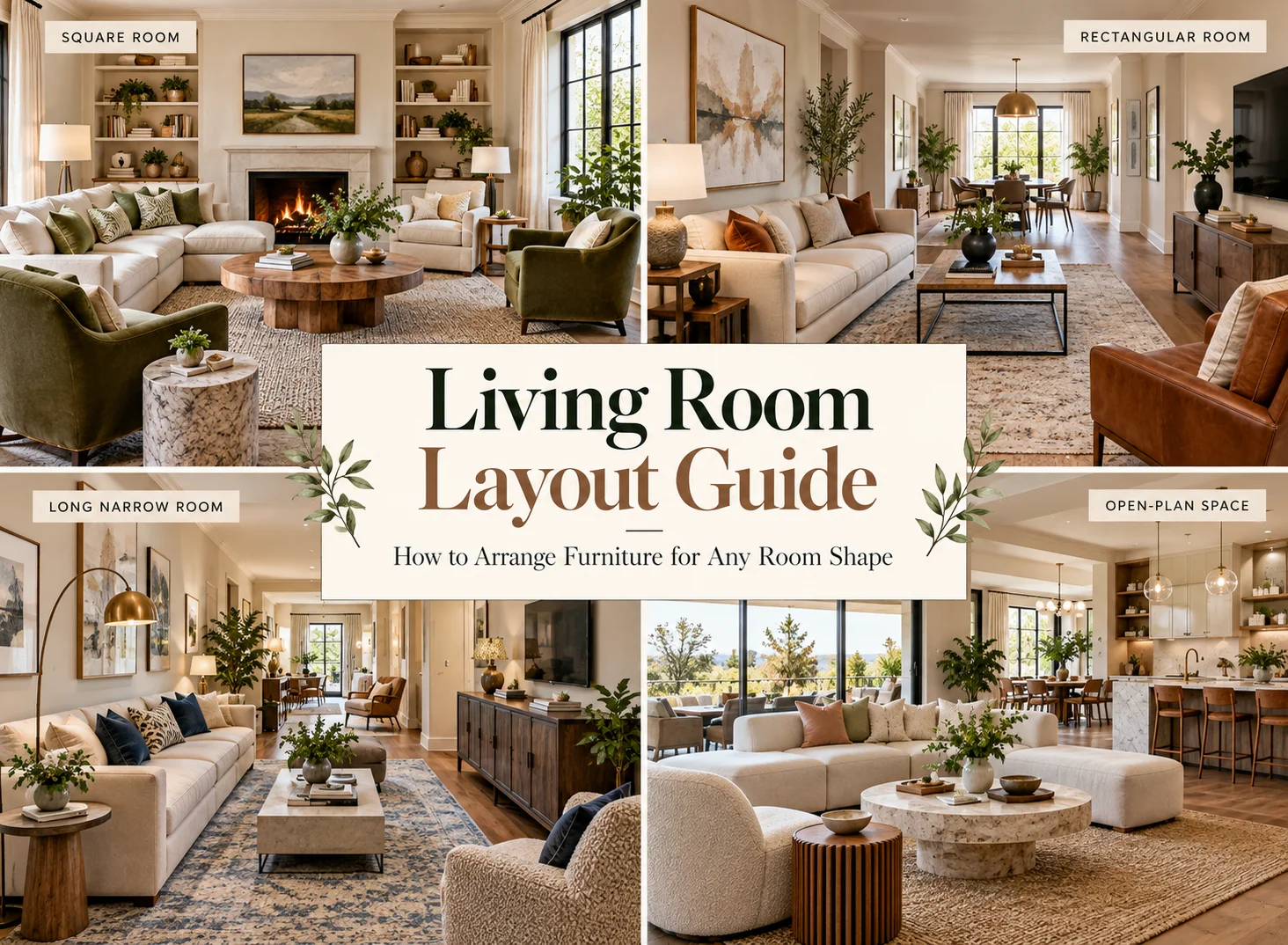
Create Functional Groupings
Arrange furniture around activities.
Living-room seating should support conversation. Dining areas should allow easy movement around the table. Bedroom furniture should provide comfortable circulation rather than merely fitting against available walls.
Use Large Rugs
A rug should visually connect furniture rather than float underneath the coffee table.
In living spaces, placing at least the front legs of the major seating pieces on the rug generally creates a stronger composition.
Protect Circulation
Keep clear routes between entrances, doors and frequently used areas.
Leave Some Space Empty
Contemporary interiors benefit from visual pauses. You do not need to solve every blank wall or unused corner with another object.
Walls, Artwork and Architectural Features
Contemporary walls can be extremely simple or highly architectural.
Large-Scale Artwork
One substantial piece often works better than numerous unrelated small pictures.
Abstract paintings, photography, graphic compositions and dimensional works can all complement contemporary interiors.
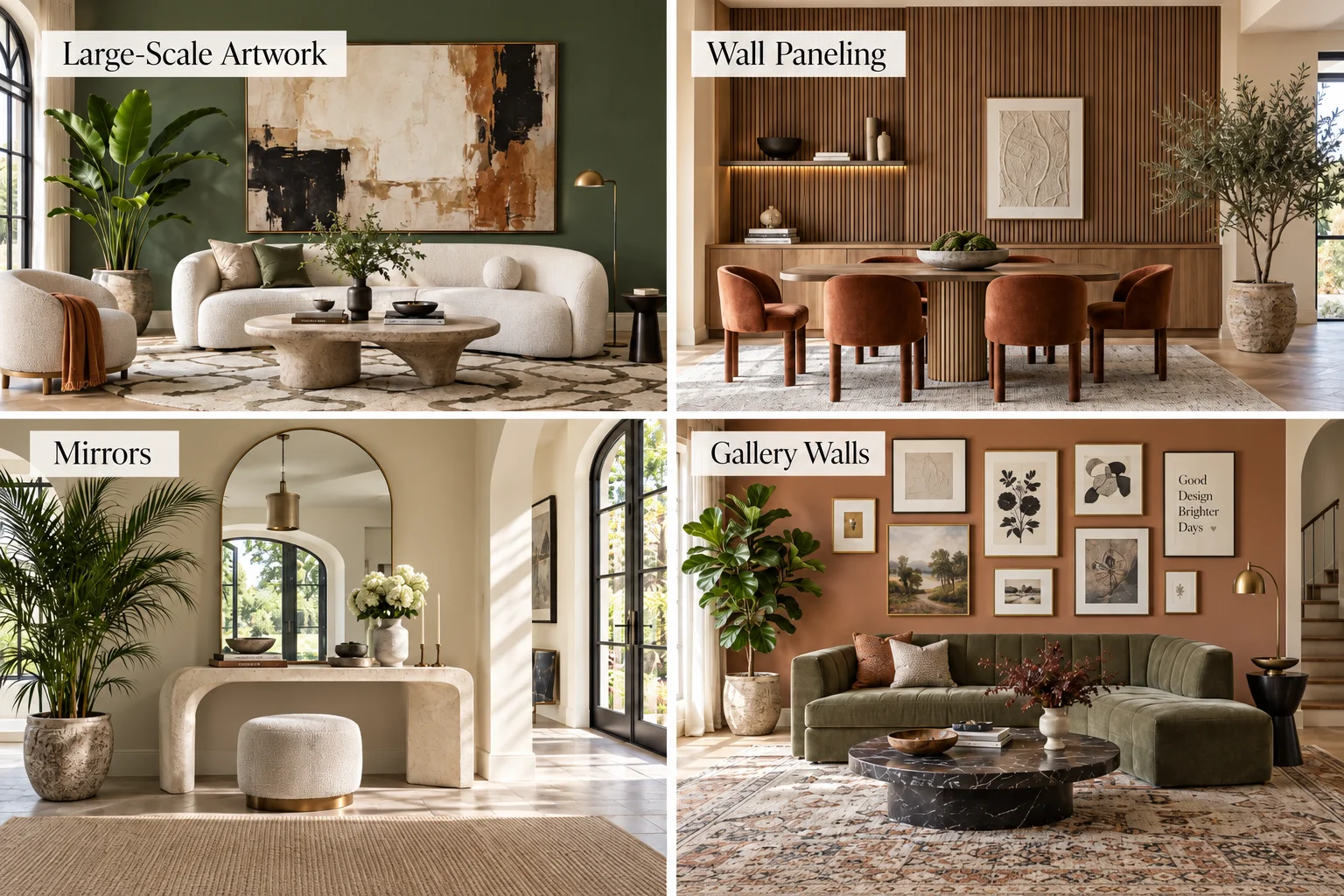
Wall Paneling
Wood, plaster, stone or integrated cabinetry can transform an otherwise plain wall into an architectural feature.
Mirrors
Use large mirrors to reflect daylight or introduce a strong geometric or organic shape.
Gallery Walls
Gallery walls can work in contemporary spaces, but keep the composition deliberate. Consistency can come from framing, spacing, color or subject matter rather than forcing every artwork to match.
Contemporary Decor and Accessories
Contemporary decorating favors editing rather than elimination.
Your home should still contain objects that reflect your interests and experiences.
Useful Accessories
- handmade ceramics;
- sculptural bowls;
- design and art books;
- simple trays;
- candlesticks;
- vases;
- framed photographs;
- textile cushions;
- natural branches or greenery;
- small sculptural objects.
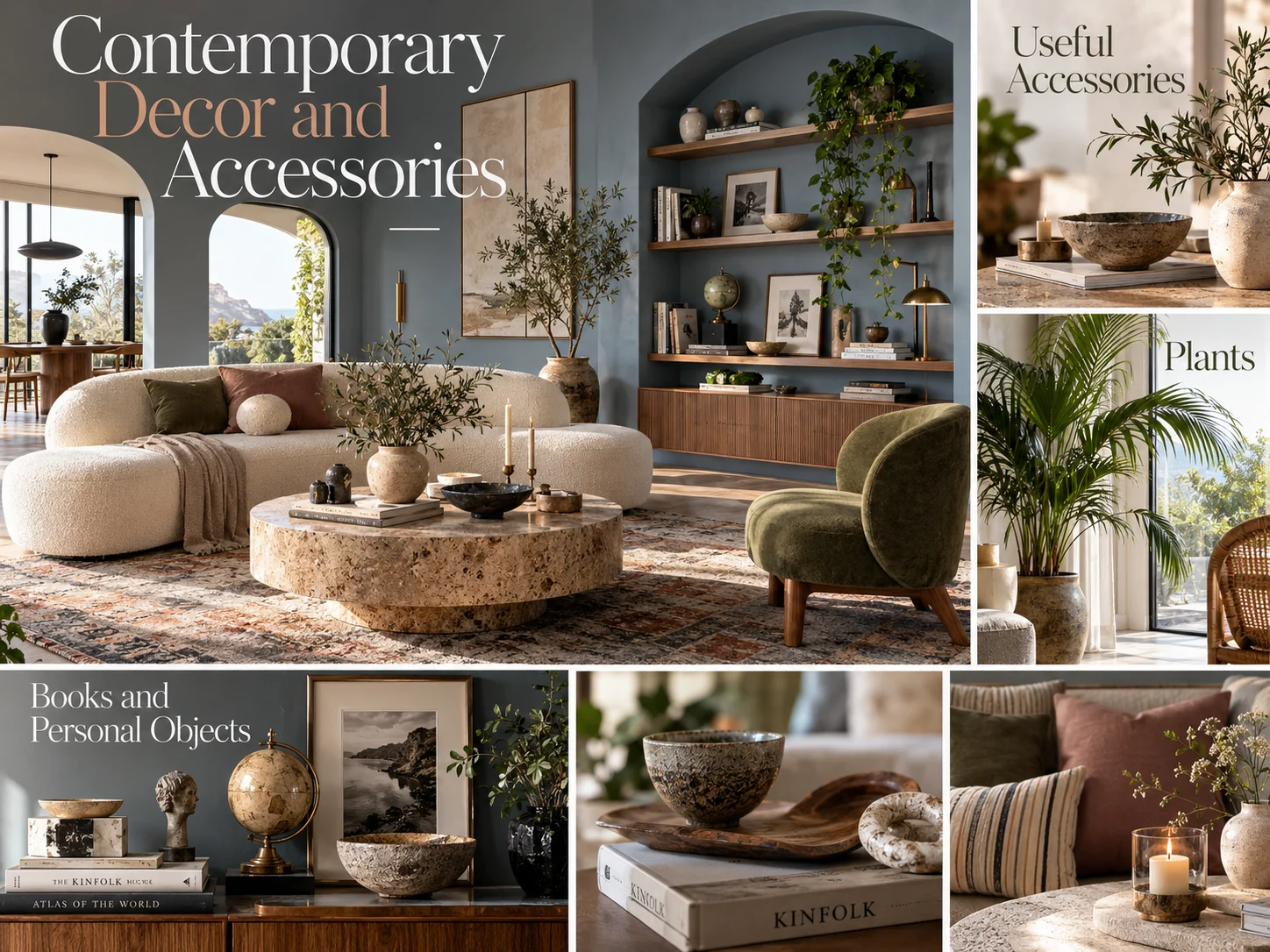
Plants
Plants introduce irregular organic forms that contrast beautifully with contemporary architecture.
One substantial fiddle-leaf fig, rubber plant, Kentia palm, olive tree or Ficus Audrey may be more visually effective than numerous small plants distributed around the room.
Books and Personal Objects
Contemporary should not mean anonymous.
Books, travel objects, collected ceramics and family photographs can make a clean room feel personal without creating clutter when they are arranged selectively.
Contemporary Interior Design Room by Room
Contemporary Living Room
Start with comfortable seating, a properly scaled rug and a clear furniture arrangement. Add material contrast through timber, stone, glass and textiles.
A large artwork or distinctive light fixture can become the primary focal point, while accessories remain restrained.
For a complete breakdown of sofas, rugs, lighting, curtains, artwork, plants and layouts, read our Contemporary Living Room Style Guide.
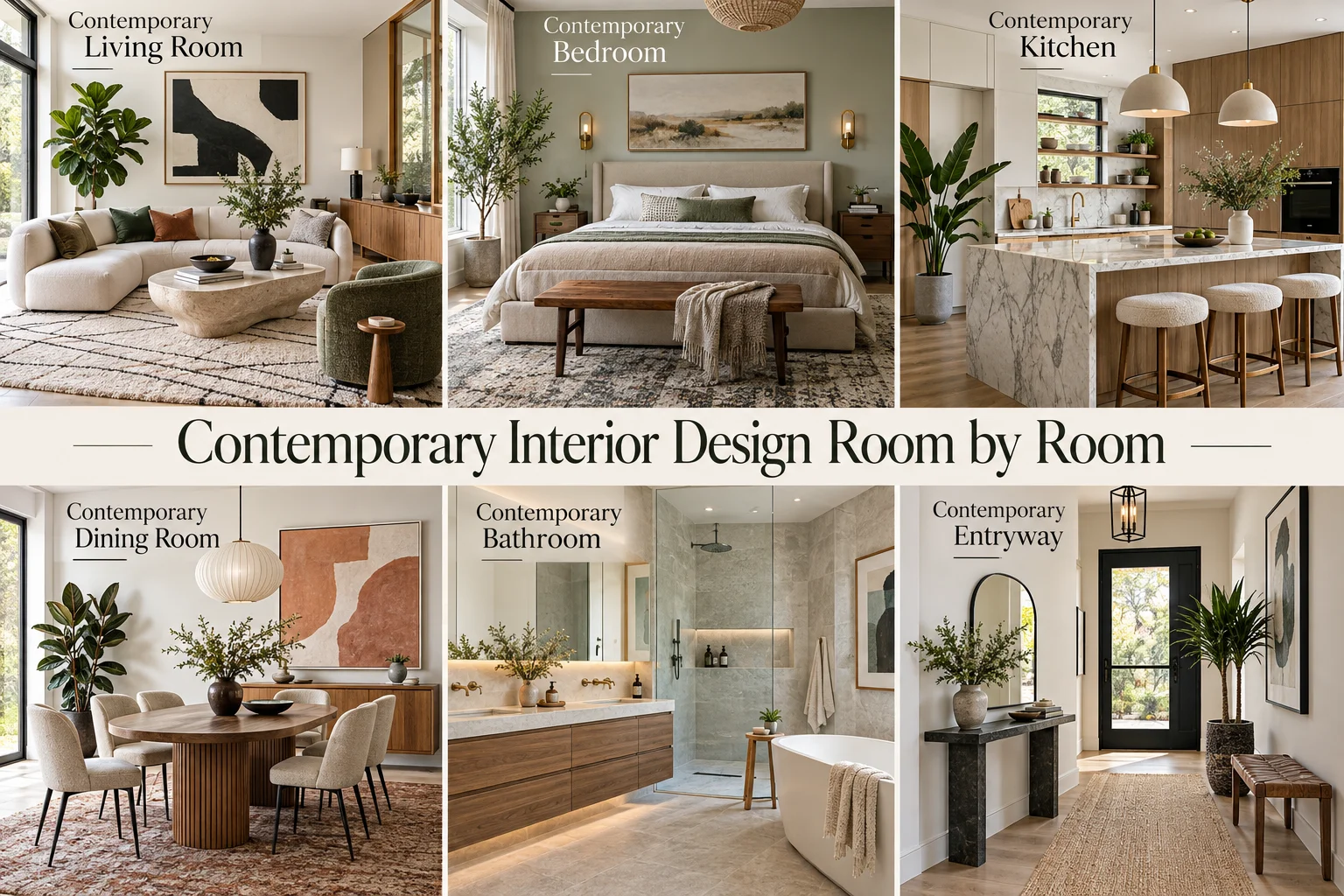
Contemporary Bedroom
Keep the bedroom visually quieter than shared living spaces.
Use a strong upholstered or timber bed as the anchor, then add simple bedside tables, soft textiles, controlled artwork and layered lighting.
Wall-mounted sconces can free bedside surfaces while giving the room a more architectural appearance.
Contemporary Kitchen
Contemporary kitchens benefit from simple cabinetry combined with tactile materials.
Handleless or minimally detailed doors can provide a clean foundation, while natural stone, timber, interesting hardware and carefully selected lighting prevent the space from feeling clinical.
Avoid assuming that every surface must match. Subtle material contrast often creates greater depth.
Contemporary Dining Room
Begin with the table.
A simple timber or stone table can anchor the space, followed by comfortable chairs and a pendant positioned to reinforce the table’s shape.
Keep centerpieces low enough to preserve conversation across the table.
Contemporary Bathroom
Large-format surfaces, clean cabinetry, frameless glass and simple fittings create a useful foundation.
Warm the room with timber cabinetry, textured towels, stone, brushed metal or indirect lighting.
Contemporary Entryway
An entry requires relatively little furniture.
A narrow console or bench, mirror, practical lighting and one decorative object may be enough.
Prioritize clear circulation and storage for items that would otherwise create visual clutter.
Contemporary Interior Design for Small Spaces
Contemporary design can work especially well in apartments and compact homes because it encourages careful editing and functional planning.
Choose Fewer, Better-Sized Pieces
Do not automatically buy miniature furniture.
A properly sized sofa and one comfortable chair may make a small room feel calmer than numerous narrow pieces.
Use Visual Continuity
Repeating related colors and materials throughout adjoining spaces can make the home feel more connected.
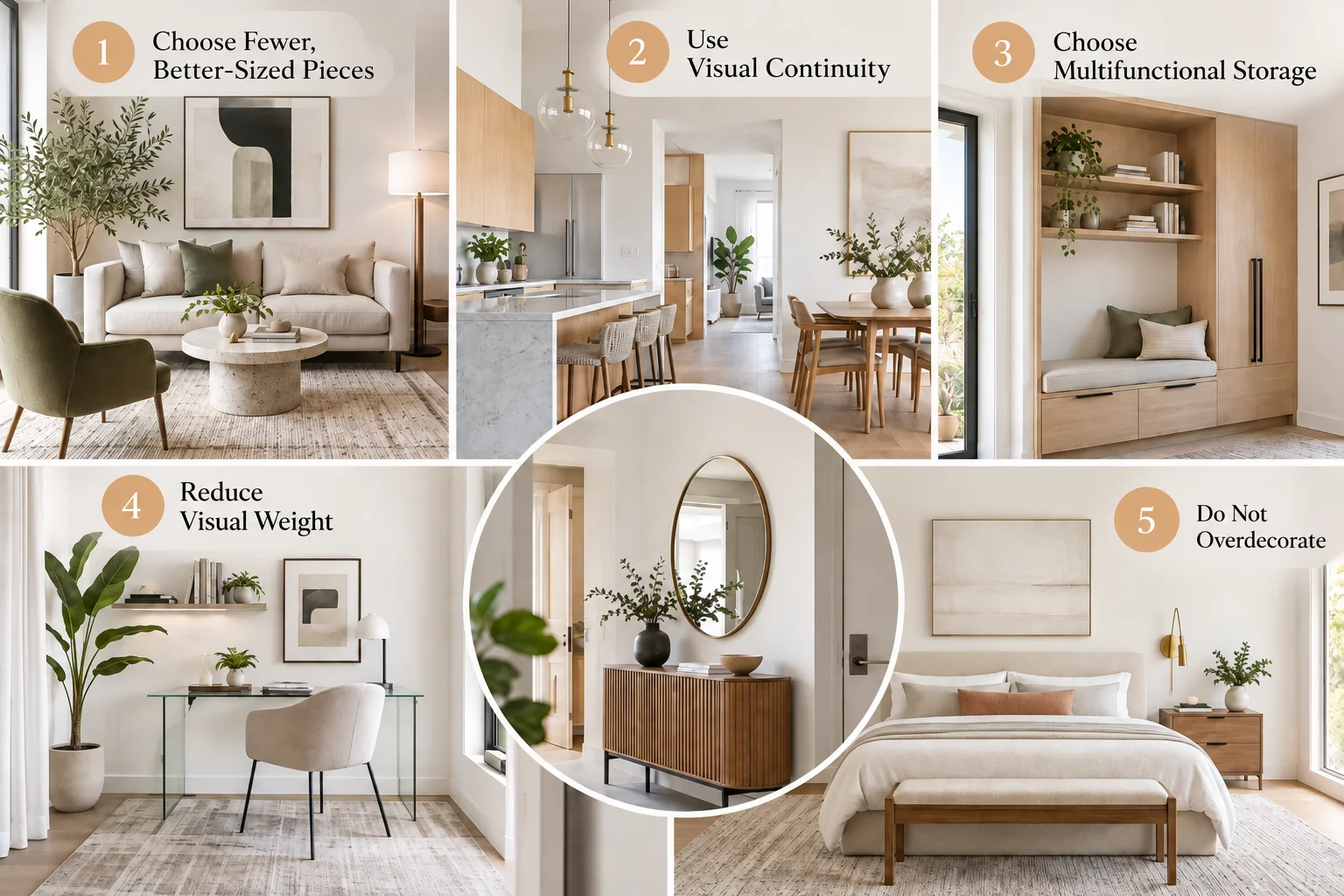
Choose Multifunctional Storage
Storage benches, closed consoles and integrated cabinetry allow practical objects to remain accessible without dominating the room.
Reduce Visual Weight
Raised furniture, glass elements, open-legged tables and wall-mounted pieces can reveal more floor area.
Do Not Overdecorate
In compact rooms, every decorative object carries more visual weight. Leave enough empty space for the important pieces to register clearly.
Contemporary Style Variations
Because contemporary design is flexible, it combines naturally with several related aesthetics.
Warm Contemporary
Warm contemporary interiors use cream, taupe, brown, timber and tactile fabrics to soften clean architectural forms.
Organic Contemporary
Combine contemporary simplicity with natural stone, wood, linen, plaster, irregular shapes and greenery.
If you prefer this softer interpretation, explore our Organic Modern Living Room Style Guide.
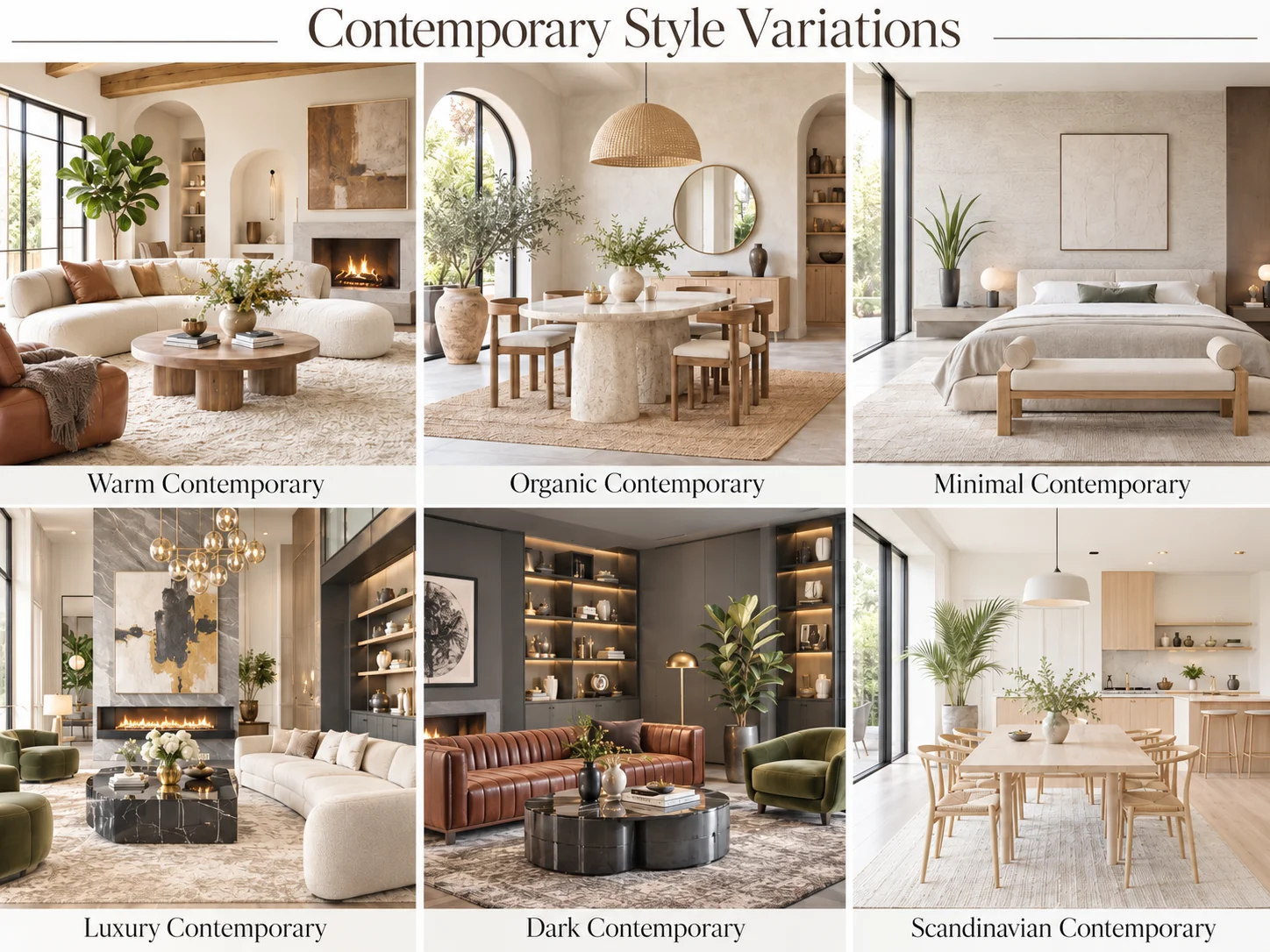
Minimal Contemporary
Reduce the palette and number of objects while placing greater emphasis on architecture, proportion and material quality.
Luxury Contemporary
Use premium stone, custom cabinetry, large-format artwork, sophisticated lighting and carefully detailed furniture.
The goal is refinement rather than obvious extravagance.
Dark Contemporary
Charcoal, chocolate brown, espresso, muted olive and deep taupe can create a more dramatic atmosphere when balanced with warm lighting and varied texture.
Scandinavian Contemporary
Pair contemporary silhouettes with pale timber, practical furniture, soft textiles and abundant natural light.
For a more distinctly Nordic approach, see our Scandinavian Living Room Style Guide.
Contemporary — Shop the Look
If you are furnishing a contemporary home from scratch, invest first in foundational furniture and lighting. Decorative accessories should complete the room rather than establish the entire style.
| Element | What to Look For |
|---|---|
| Sofa | Comfortable low- or medium-profile design in a warm neutral or restrained color |
| Accent Chair | Sculptural upholstered chair or refined timber-frame lounge chair |
| Coffee Table | Stone, solid wood, glass or mixed-material architectural design |
| Dining Table | Simple substantial form in timber, stone or a complementary material combination |
| Storage | Low-profile closed cabinetry or integrated storage |
| Rug | Large wool or textured rug with restrained pattern |
| Curtains | Full-length linen or softly woven panels |
| Lighting | One statement fixture supported by floor, wall and table lighting |
| Artwork | Large abstract, photographic or dimensional statement piece |
| Accessories | Ceramics, books, bowls, vessels and personal objects |
| Greenery | One or two architectural plants in simple planters |
Shopping Rule: Prioritize the sofa, dining furniture, rugs, storage and major lighting before buying decorative accessories. Good proportions will influence the room far more than small styling pieces.
How to Create a Contemporary Interior Step by Step
1. Decide How the Room Needs to Function
Identify the activities the space must support before choosing furniture.
2. Establish a Simple Foundation
Choose flooring, walls and large architectural surfaces that can support the rest of the design.
3. Select the Main Furniture
Prioritize comfort, scale and proportion.
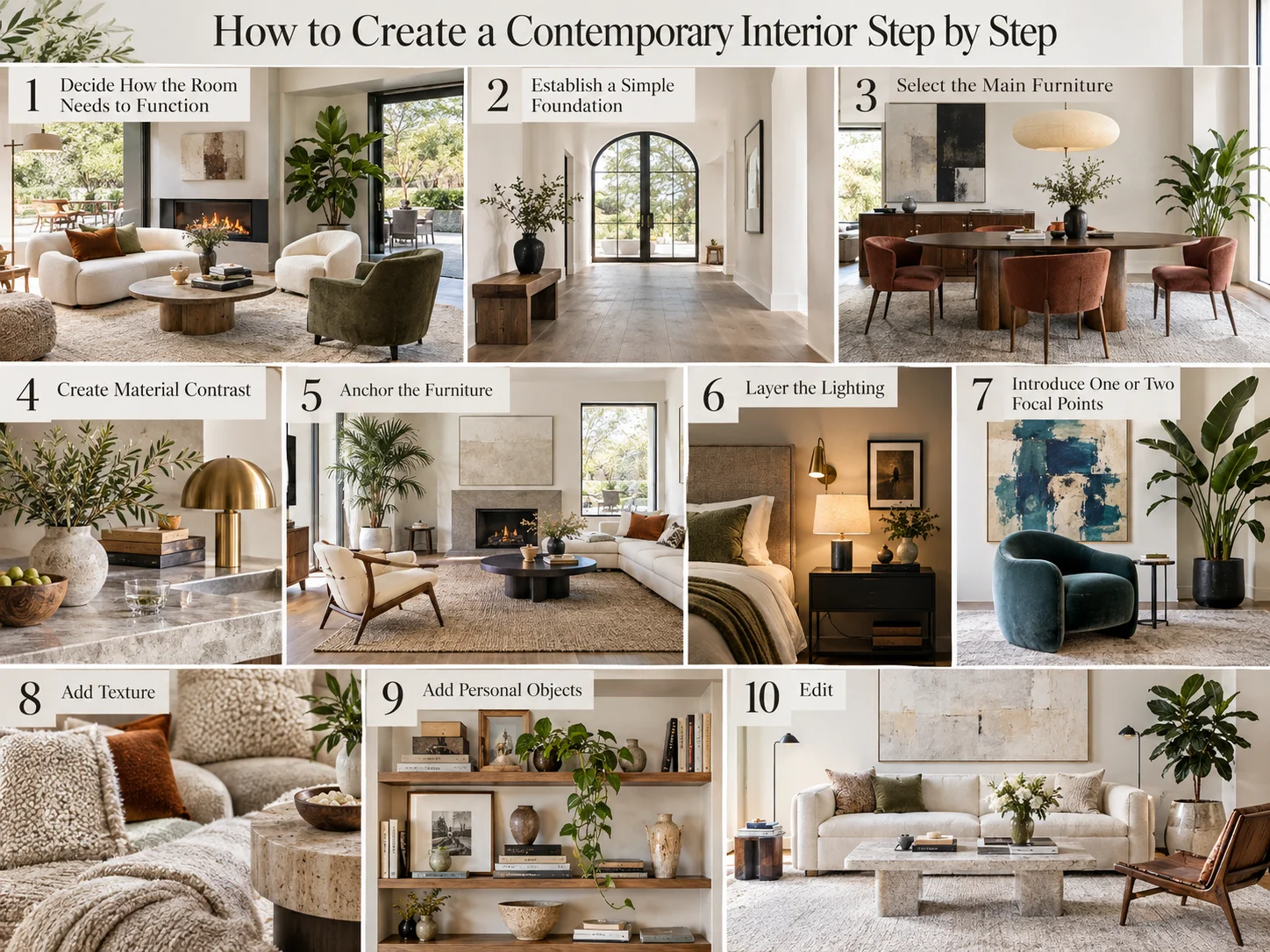
4. Create Material Contrast
Introduce a controlled combination of timber, stone, textile, metal or glass.
5. Anchor the Furniture
Use an appropriately sized rug or clear furniture grouping to establish visual structure.
6. Layer the Lighting
Combine ambient, task and accent lighting rather than relying on one ceiling fixture.
7. Introduce One or Two Focal Points
Choose a substantial artwork, distinctive chair, sculptural light or architectural feature.
8. Add Texture
Use rugs, curtains, upholstery and natural surfaces to prevent simplicity from feeling flat.
9. Add Personal Objects
Books, ceramics, photographs and collected pieces make the room feel lived in.
10. Edit
Remove objects that compete with the main composition without contributing function, texture, meaning or balance.
Common Contemporary Decorating Mistakes
Making Everything Neutral
Neutral colors are useful foundations, but an entirely flat beige or gray room can feel unfinished.
The fix: Introduce contrast through material, texture, dark accents, art or controlled color.
Confusing Contemporary With Minimalist
A contemporary interior does not need to be nearly empty.
The fix: Keep meaningful objects, comfortable furniture and useful decoration while editing visual clutter.
Following Too Many Trends
Because contemporary design reflects the present, it is tempting to fill the house with whatever is currently fashionable.
The fix: Use trend-driven elements selectively. Let architectural decisions, quality materials and foundational furniture provide longevity.
Choosing Furniture for Appearance Alone
Beautiful furniture that is uncomfortable or impractical undermines the purpose of a home.
The fix: Evaluate dimensions, comfort, durability and everyday use before aesthetics.
Buying Matching Furniture Sets
Too much coordination can make a room feel like a showroom.
The fix: Combine compatible materials and forms rather than identical collections.
Using Too Many Small Accessories
Large contemporary spaces can quickly become visually fragmented when filled with numerous tiny objects.
The fix: Use fewer, larger accessories with interesting shapes or materials.
Ignoring Lighting
Excellent furniture can still feel flat under one harsh overhead fixture.
The fix: Layer light at different heights and include dimmable sources where practical.
Forgetting Personality
A room can be perfectly coordinated and still feel generic.
The fix: Include art, books, photographs, handmade objects and collected pieces that have personal relevance.
Contemporary Interior Design Rules You Can Use in Any Room
- Start with function. Design around the way the room will actually be used.
- Prioritize proportion. The right scale matters more than the number of objects.
- Leave negative space. Not every surface, wall and corner needs decoration.
- Mix straight and organic forms. Contrast creates visual movement.
- Layer materials. Wood, stone, metal, glass and textiles create depth.
- Add texture before unnecessary decoration.
- Use color intentionally. Neutral does not need to mean colorless.
- Invest in foundational furniture first.
- Avoid matching everything perfectly.
- Use several lighting sources.
- Choose fewer accessories with greater impact.
- Keep personal objects. Contemporary homes should still tell a story.
- Use trends selectively. Current should not automatically mean temporary.
- Edit when the room feels busy.
Is Contemporary Interior Design Right for You?
Contemporary design may suit you if you appreciate clean spaces but do not want the strictness sometimes associated with minimalist interiors.
It works particularly well for people who enjoy:
- simple but distinctive furniture;
- comfortable modern living;
- neutral palettes with controlled color;
- natural stone and timber;
- sculptural lighting;
- large artwork;
- uncluttered surfaces;
- flexibility rather than rigid historical rules.
It may be less suitable if you prefer highly ornate furniture, dense collections, strongly historical interiors or abundant pattern throughout every surface.
However, because contemporary design is flexible, elements of those preferences can still be incorporated when the overall composition remains intentional.
Frequently Asked Questions About Contemporary Interior Design
What is contemporary interior design?
Contemporary interior design is an evolving style based on the design ideas, materials and lifestyles considered relevant to the present. It generally emphasizes clean composition, functional spaces, quality materials, comfortable furniture and intentional decoration.
What is the difference between contemporary and modern interior design?
Modern design is associated primarily with twentieth-century Modernism and related movements. Contemporary design refers to current design and therefore continues to evolve over time.
What colors are used in contemporary interior design?
Warm white, cream, beige, greige, taupe, brown and soft gray frequently form the foundation. These can be combined with black, charcoal and muted or saturated accent colors depending on the desired atmosphere.
Does contemporary design have to be neutral?
No. Neutral foundations are common, but contemporary interiors can include substantial color. The important factor is controlling the palette so individual colors contribute to the composition rather than competing with one another.
What materials are common in contemporary interiors?
Wood, natural stone, glass, metal, linen, wool, cotton, plaster and other tactile materials are commonly combined to create contrast and depth.
Is contemporary interior design minimalist?
Not necessarily. Contemporary design often uses visual restraint and negative space, but it can contain more decoration, color, texture and furniture than a strongly minimalist interior.
Can contemporary design feel warm?
Yes. Timber, warm neutrals, natural stone, tactile rugs, linen curtains, comfortable upholstery, plants and layered lighting can make contemporary interiors feel highly inviting.
Can you mix contemporary furniture with vintage pieces?
Yes. One or two vintage pieces can add character and prevent a contemporary room from looking overly coordinated. Choose pieces whose scale, material or shape relates to the rest of the room.
How do you make a contemporary home look timeless?
Invest in good proportions, durable materials and comfortable foundational furniture. Use highly trend-specific colors, accessories and decorative motifs in smaller doses so they can evolve without requiring a complete redesign.
What is the easiest way to make a room look contemporary?
Reduce unnecessary clutter, improve the furniture arrangement, use a properly scaled rug, introduce natural materials, layer the lighting and replace numerous small accessories with a few more substantial objects.
Final Thoughts
Contemporary interior design succeeds because it does not demand that your home conform to one rigid historical formula.
Instead, it provides a framework for creating spaces that feel relevant to the way people live now: comfortable furniture, practical layouts, thoughtful storage, quality materials, layered lighting and enough visual breathing room for individual pieces to matter.
The strongest contemporary interiors also resist the temptation to become catalogs of current trends. They use contemporary ideas selectively while allowing craftsmanship, proportion, architecture and personal objects to give the home longevity.
Start with function and scale. Establish a calm foundation. Introduce contrasting materials and shapes. Invest in good furniture and lighting. Then add artwork and objects that make the space recognizably yours.
The result should feel current without feeling temporary, sophisticated without feeling untouchable and carefully designed without losing the comfort that makes a house a home.
Home Style Studio Co. Recommendation: If you are beginning with one room, start with the living room. Establish the sofa, rug, layout and lighting first, then use those decisions to develop a consistent material and color language throughout the rest of your home. Continue with our Contemporary Living Room Style Guide for the complete room-by-room styling process.
Article Summary
- Contemporary design reflects present-day design rather than one fixed historical period.
- Clean composition, comfortable furniture and intentional negative space form its foundation.
- Natural materials and varied textures prevent restrained palettes from feeling flat.
- Contemporary and modern design overlap but are not identical.
- Furniture should prioritize proportion, comfort and function.
- Layered lighting is essential to creating depth and atmosphere.
- Contemporary homes can be warm, organic, minimal, dramatic or luxurious.
- Trends should complement durable design decisions rather than replace them.
- Personal art, books and collected objects keep contemporary interiors from feeling generic.
Editor’s Note: Contemporary interior design will continue to evolve, which is exactly why its fundamental principles matter more than individual trends. Use proportion, function, quality materials and visual balance as your foundation, then allow colors, furniture and accessories to change naturally as your home and personal style develop.