Japandi and Scandinavian interiors can look remarkably similar at first glance. Both favor simplicity, natural materials, functional furniture and calm, uncluttered rooms. Look closer, however, and the differences become much easier to recognize.
Scandinavian design generally feels lighter, brighter and more casual, while Japandi interiors are usually more restrained, earthy and contemplative. Scandinavian rooms often emphasize everyday comfort and approachable warmth. Japandi takes many of those ideas and combines them with Japanese influences such as craftsmanship, imperfection, lower furniture and greater visual restraint.
If you are deciding between the two styles—or wondering why rooms labeled Japandi and Scandinavian sometimes appear almost identical—this comparison explains where they overlap, where they differ and which aesthetic may suit your home best.
Japandi vs Scandinavian Design at a Glance
| Design Element | Japandi | Scandinavian |
|---|---|---|
| Overall Mood | Calm, grounded and contemplative | Bright, relaxed and welcoming |
| Color Palette | Warm neutrals, earthy shades and darker accents | White, pale neutrals and soft muted colors |
| Wood | Light and dark timber often combined | Primarily pale woods such as oak, ash and birch |
| Furniture | Low-profile, refined and often handcrafted | Functional, comfortable and visually light |
| Decoration | Highly edited and intentional | Minimal but often more personal and relaxed |
| Texture | Linen, timber, stone, clay, plaster and handmade finishes | Wool, linen, timber, cotton and cozy textiles |
| Contrast | Moderate to strong tonal contrast | Usually lighter and softer |
| Atmosphere | Quiet simplicity | Comfortable simplicity |
What Is Scandinavian Interior Design?
Scandinavian interior design developed around the idea that homes should be beautiful, functional and comfortable for everyday life. The style is associated with Nordic countries and is recognized for its light-filled rooms, practical furniture, natural materials and uncomplicated forms.
Pale walls and light timber are common because they help maximize available light. Soft textiles, rugs, cushions and warm lighting prevent the simplicity from feeling cold.

A typical Scandinavian room might include a light oak table, neutral sofa, wool rug, simple ceramic accessories, comfortable lounge chair and several carefully chosen personal objects.
The overall effect is minimal without necessarily feeling austere.
For a deeper explanation of the philosophy behind the aesthetic, see our guide to Scandinavian design principles.
What Is Japandi Interior Design?
Japandi interior design is a contemporary fusion of Japanese and Scandinavian design influences. Rather than simply combining Japanese furniture with Scandinavian decor, the style focuses on ideas both traditions already share: simplicity, natural materials, craftsmanship, functionality and appreciation for well-made objects.
Japanese influence generally introduces greater restraint, darker timber, organic forms, imperfect handcrafted surfaces and a closer relationship with nature.

Scandinavian influence contributes functionality, comfort, approachable minimalism and an emphasis on creating a livable home.
The result is an interior that often feels warmer and earthier than conventional minimalism yet more edited than many Scandinavian rooms.
Our guide to Japandi design principles explores these ideas in greater depth.
What Do Japandi and Scandinavian Design Have in Common?
The reason these styles work together so naturally is that they share several fundamental design principles.
1. Simplicity Comes First
Neither style depends on excessive decoration. Furniture has room to breathe, layouts remain visually clear and unnecessary objects are usually removed.
This does not mean the rooms are empty. Instead, both styles encourage choosing objects deliberately rather than filling every available surface.

2. Natural Materials Are Essential
Timber is central to both aesthetics. Linen, cotton, wool, stone, ceramic and other tactile materials are also frequently used.
Natural surfaces soften minimalist interiors while introducing variation through grain, weave and subtle imperfections.
3. Function Matters as Much as Appearance
A beautiful chair that is uncomfortable or a minimalist cabinet that cannot accommodate everyday storage does not fully reflect either philosophy.
Both approaches prioritize spaces that support daily life rather than interiors created purely for visual impact.
4. Craftsmanship Is Valued
Well-designed furniture, handmade ceramics and durable natural materials fit comfortably into both styles.
Quality tends to matter more than quantity.
5. Nature Influences the Interior
Wood, stone, plants, natural fabrics and organic shapes help both Scandinavian and Japandi rooms maintain a connection with the natural world.
Large windows and natural light also play an important role whenever the architecture allows.
What Is the Main Difference Between Japandi and Scandinavian Design?
The largest difference is not one particular piece of furniture or color. It is the overall degree of visual restraint and atmosphere.
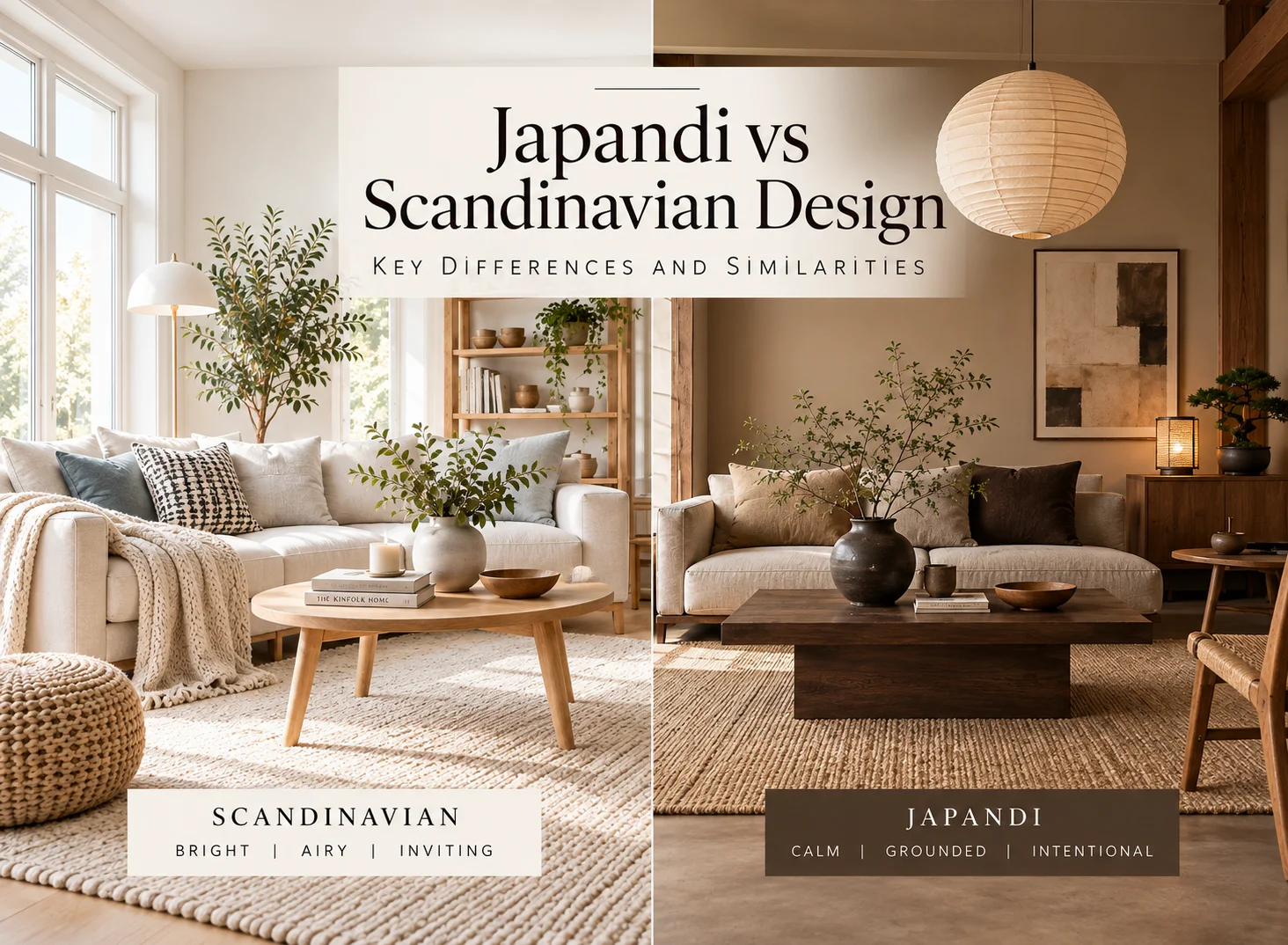
Scandinavian interiors generally feel lighter, softer and more informal. Japandi interiors often feel quieter, more grounded and deliberately edited.
You can see this distinction across several individual design elements.
1. Japandi Color Palettes Are Usually Earthier
Scandinavian rooms are famous for bright neutral foundations. White, warm white, pale grey, beige and soft muted colors are commonly paired with blonde timber.
Japandi palettes usually move further toward nature-inspired earth tones.

Think:
- warm stone;
- mushroom;
- taupe;
- sand;
- clay;
- muted olive;
- charcoal; and
- deep brown.
White can certainly appear in a Japandi home, but softer off-whites and warmer neutrals are often more characteristic than crisp bright white.
2. Scandinavian Design Uses More Light Wood
Pale timber is one of the most recognizable Scandinavian design features. Oak, ash, birch and similar finishes keep interiors feeling airy and visually lightweight.

Japandi interiors can use the same pale woods, but they are more likely to combine them with medium or dark timber.
A light oak dining table might sit beside dark-stained chairs, for example, or a pale timber room may be grounded by a walnut cabinet.
This wider tonal range gives Japandi interiors greater depth and contrast.
3. Japandi Furniture Often Sits Lower
Furniture proportions can create another noticeable distinction.
Scandinavian furniture is typically streamlined and functional, often featuring slender legs that visually lift pieces from the floor.
Japandi furniture frequently has a lower center of gravity. Low sofas, platform beds, substantial coffee tables and grounded timber pieces help create a calmer horizontal composition.
The influence does not need to be literal. You do not need every piece of furniture close to the floor. Even one or two lower elements can shift the atmosphere toward Japandi.
4. Scandinavian Interiors Often Feel Cozier
Both styles value comfort, but Scandinavian design tends to express it more visibly through textiles and familiar domestic details.

You may see:
- layered cushions;
- wool blankets;
- soft rugs;
- books;
- candles;
- small artworks; and
- personal decorative objects.
Japandi can include all of these, but usually with greater editing.
Rather than several cushions, there may be one or two. Instead of a collection of small objects, a single handmade ceramic vessel may occupy the surface.
5. Japandi Emphasizes Imperfection More Strongly
One of the Japanese influences often associated with Japandi is an appreciation for natural variation, aging and imperfect craftsmanship.
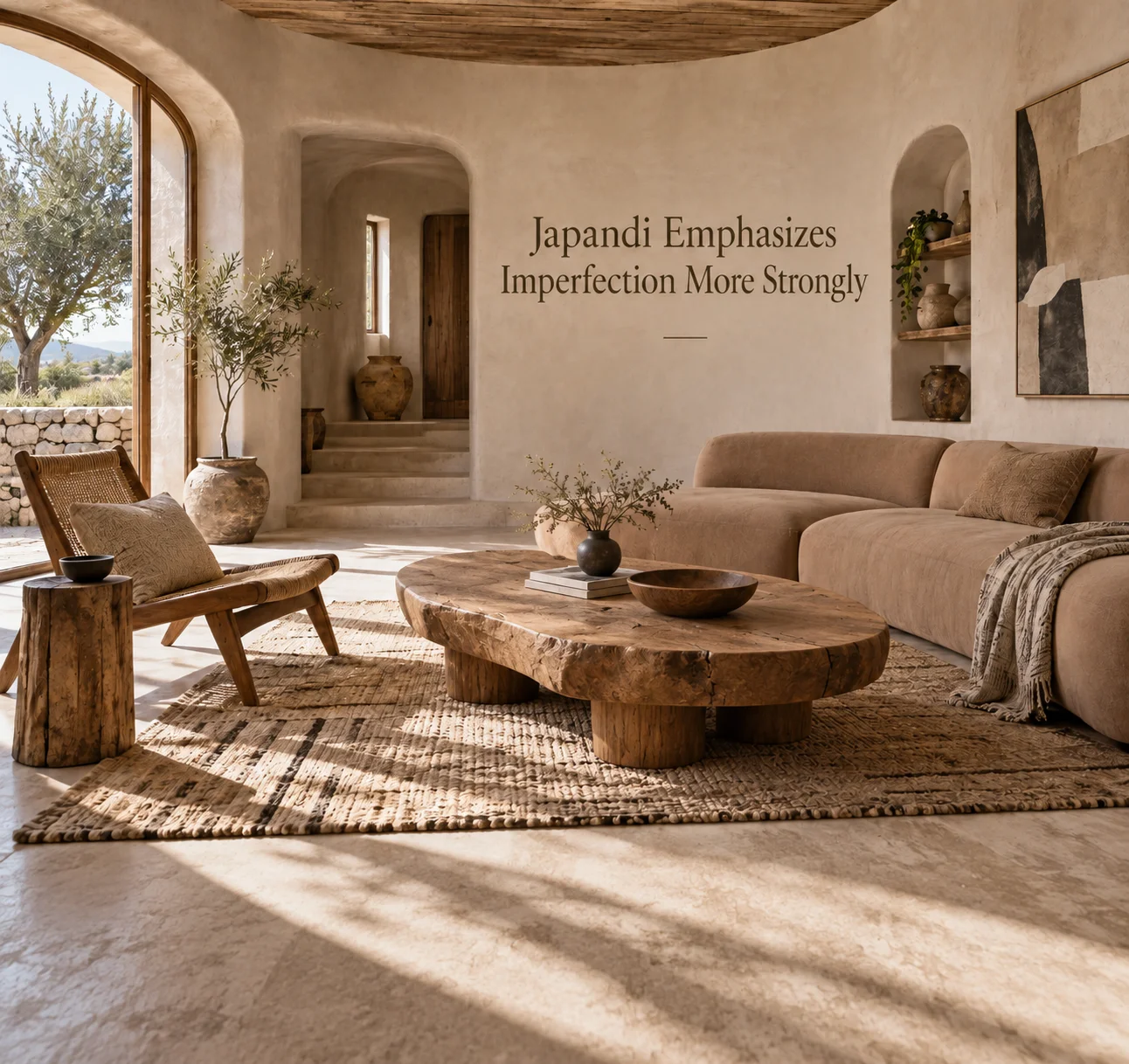
A slightly irregular ceramic bowl, timber with visible grain or textured plaster wall can therefore feel more appropriate than a perfectly uniform manufactured finish.
Scandinavian design also values natural materials and craftsmanship, but its appearance often feels slightly cleaner and more streamlined.
6. Scandinavian Decor Can Be More Playful
Scandinavian rooms often allow more freedom for subtle color, graphic artwork and familiar decorative accents.

Muted blue, dusty pink, sage green or ochre can be introduced without changing the overall style.
Japandi decoration is normally quieter. Artwork tends to be restrained, accessories fewer and color transitions softer.
That makes Scandinavian interiors particularly appealing if you enjoy minimalism but still want visible personality throughout the room.
7. Japandi Creates Stronger Visual Contrast
A Scandinavian room may remain predominantly pale from walls to furniture and flooring.
Japandi interiors often benefit from a deliberate darker element.
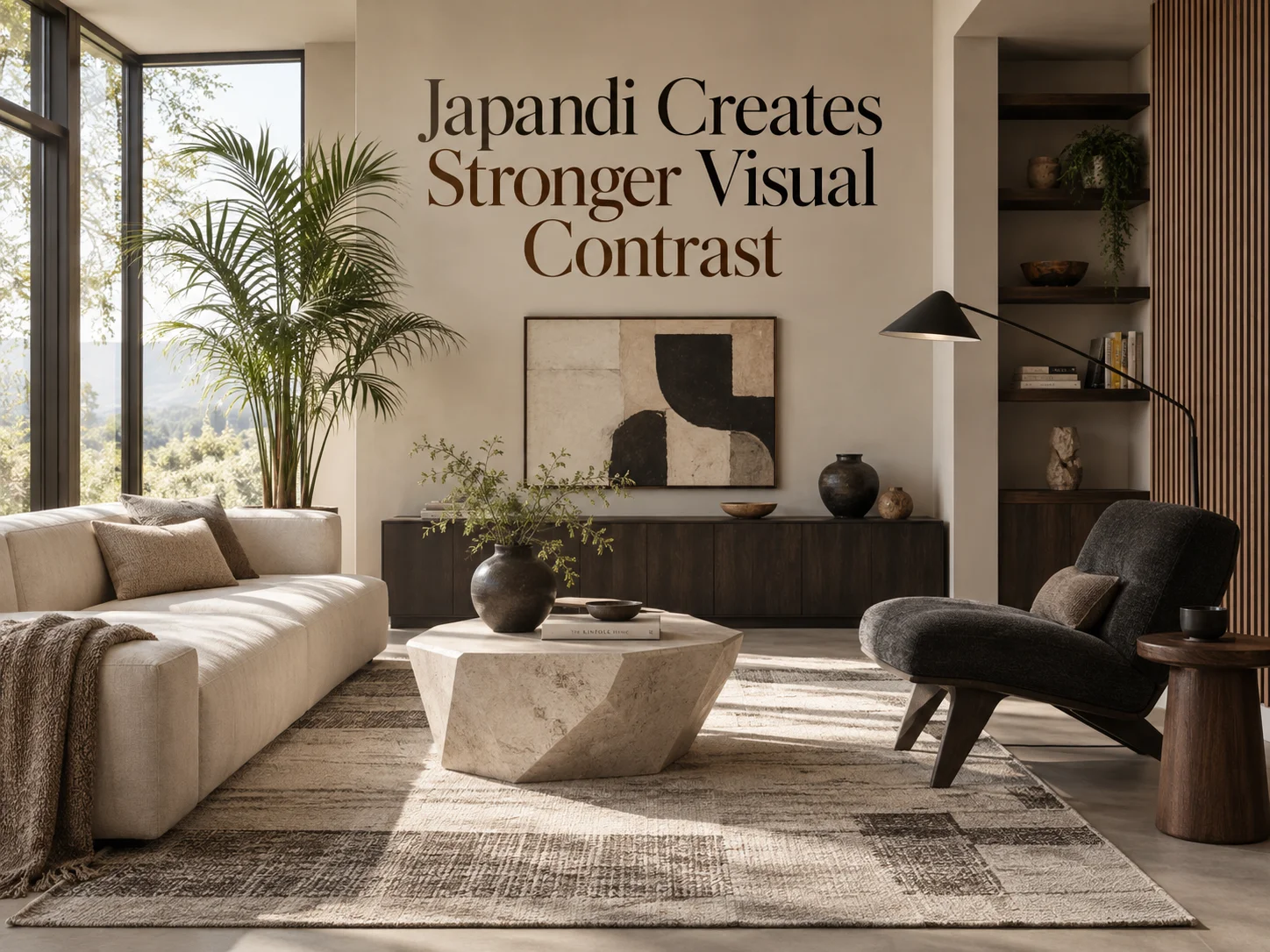
This could be:
- a dark timber cabinet;
- charcoal lounge chair;
- black metal light fitting;
- deep brown side table; or
- dark ceramic vessel.
The contrast helps anchor an otherwise neutral interior without requiring bold color.
Japandi vs Scandinavian Living Rooms
The distinction becomes particularly clear when comparing living rooms.
A Scandinavian living room might feature pale oak floors, a light neutral sofa, slim timber furniture, a soft wool rug, several cushions, simple artwork and layered lighting.
A Japandi living room may begin with a similar neutral foundation but introduce a lower sofa, darker timber, handmade ceramics, natural stone and fewer decorative objects.
The Scandinavian version might communicate:
comfortable, light and effortless.
The Japandi interpretation might communicate:
calm, grounded and intentional.
Neither approach is inherently more minimalist. They simply express simplicity differently.
Which Style Is Warmer – Japandi or Scandinavian?
Both can create warm interiors, but they achieve warmth in different ways.
Scandinavian warmth frequently comes from textiles, lighting and everyday comfort.
Japandi warmth tends to come from natural materials, earthy color, timber variation and tactile surfaces.
If you associate coziness with blankets, cushions and softly layered furnishings, Scandinavian design may feel warmer.
If you associate warmth with wood grain, stone, textured linen, ceramics and earthy tones, Japandi may feel more appealing.
Which Style Is More Minimalist – Japandi or Scandinavian?
Japandi usually appears more visually restrained, although both styles are rooted in simplicity.
A Scandinavian home can comfortably display books, artwork, textiles and meaningful decorative objects while still maintaining a clean aesthetic.
Japandi interiors generally use fewer visible accessories and place greater emphasis on negative space.
Each object therefore tends to carry more visual importance.
This distinction is useful if traditional minimalism feels either too sparse or too impersonal. Scandinavian interiors offer a softer route toward simplicity, while Japandi provides greater visual reduction without abandoning warmth.
Japandi or Scandinavian: Which Style Is Right for You?
Choose Scandinavian design if you prefer:
- bright and airy interiors;
- pale timber;
- soft textiles and visible coziness;
- slightly more casual decoration;
- subtle color accents; and
- a relaxed family-friendly atmosphere.

Choose Japandi design if you prefer:
- earthier neutrals;
- a mixture of light and dark timber;
- lower furniture;
- handcrafted and imperfect materials;
- fewer decorative objects;
- stronger negative space; and
- a quiet, grounded atmosphere.
If your preferences fall somewhere in the middle, you do not necessarily have to choose.
Can You Mix Japandi and Scandinavian Design?
Absolutely. In fact, the styles are naturally compatible because Japandi already incorporates substantial Scandinavian influence.
A practical approach is to establish a Scandinavian foundation and gradually introduce more Japanese-inspired restraint.
For example:
- keep pale walls and a comfortable neutral sofa;
- combine light oak with one darker timber finish;
- replace numerous small accessories with fewer handcrafted objects;
- introduce linen, stone and textured ceramics;
- choose one or two lower-profile furniture pieces;
- reduce unnecessary color; and
- leave more visible space around furniture and decorative objects.
The result should not look like two competing styles placed in the same room. Focus on the principles they share and allow the differences to appear subtly.
A Simple Way to Tell Japandi and Scandinavian Interiors Apart
If you are looking at an interior and cannot determine which style it represents, examine four elements:
- Color: Is the room pale and bright or warmer and earthier?
- Wood: Is timber predominantly light, or are light and dark tones mixed?
- Decoration: Are personal accessories visibly layered or highly edited?
- Furniture: Does the room feel visually light and elevated or more grounded and low-profile?
The more the room moves toward earthy neutrals, mixed timber tones, low furniture and highly restrained decoration, the closer it usually moves toward Japandi.
Common Mistake: Treating the Styles as Completely Different
One of the easiest mistakes is trying to create dramatic distinctions between Japandi and Scandinavian design.
There is considerable overlap, and many contemporary rooms could reasonably be described using either term.
The objective should therefore not be to determine whether every individual chair or lamp is definitively “Japandi” or “Scandinavian.”
Instead, consider the complete composition.
Materials, proportions, colors, styling density and atmosphere provide a much clearer indication of the direction in which the room leans.
Final Thoughts: Japandi vs Scandinavian Design
Japandi and Scandinavian design share far more similarities than differences. Both prioritize functionality, natural materials, craftsmanship, simplicity and comfortable everyday living.
The distinction lies primarily in how those principles are expressed.
Scandinavian design is generally brighter, softer and more relaxed, while Japandi is typically earthier, more restrained and visually grounded.
If you want a light, comfortable interior with pale timber and approachable minimalism, Scandinavian design may be the better starting point.
If you prefer deeper natural tones, fewer objects, stronger craftsmanship and a quieter atmosphere, Japandi may suit you better.
And because the two styles share such compatible foundations, combining their best characteristics can produce an interior that feels timeless, functional and genuinely comfortable rather than rigidly defined by a design label.
Frequently Asked Questions about Japandi and Scandinavian Design
Is Japandi the same as Scandinavian design?
No. Japandi incorporates Scandinavian influences but combines them with Japanese design principles. Both styles value simplicity, natural materials and functionality, but Japandi generally uses earthier colors, greater visual restraint and a wider range of timber tones.
What is the biggest difference between Japandi and Scandinavian interiors?
The biggest difference is atmosphere. Scandinavian interiors are usually lighter, brighter and more casually cozy, while Japandi interiors tend to feel quieter, more grounded and deliberately edited.
Does Japandi use darker colors than Scandinavian design?
Usually, yes. Scandinavian interiors frequently emphasize pale neutrals and light woods, whereas Japandi commonly incorporates medium or dark timber, charcoal, brown and other earthy grounding tones.
Can Scandinavian furniture work in a Japandi home?
Yes. Simple Scandinavian furniture made from natural materials works particularly well. Pair it with restrained styling, tactile materials, darker accents and handcrafted objects to move the overall room toward Japandi.
Is Japandi warmer than Scandinavian style?
Both styles can feel warm. Scandinavian rooms often create warmth through cozy textiles and lighting, while Japandi typically relies more heavily on timber, earthy neutrals, natural texture and handcrafted materials.